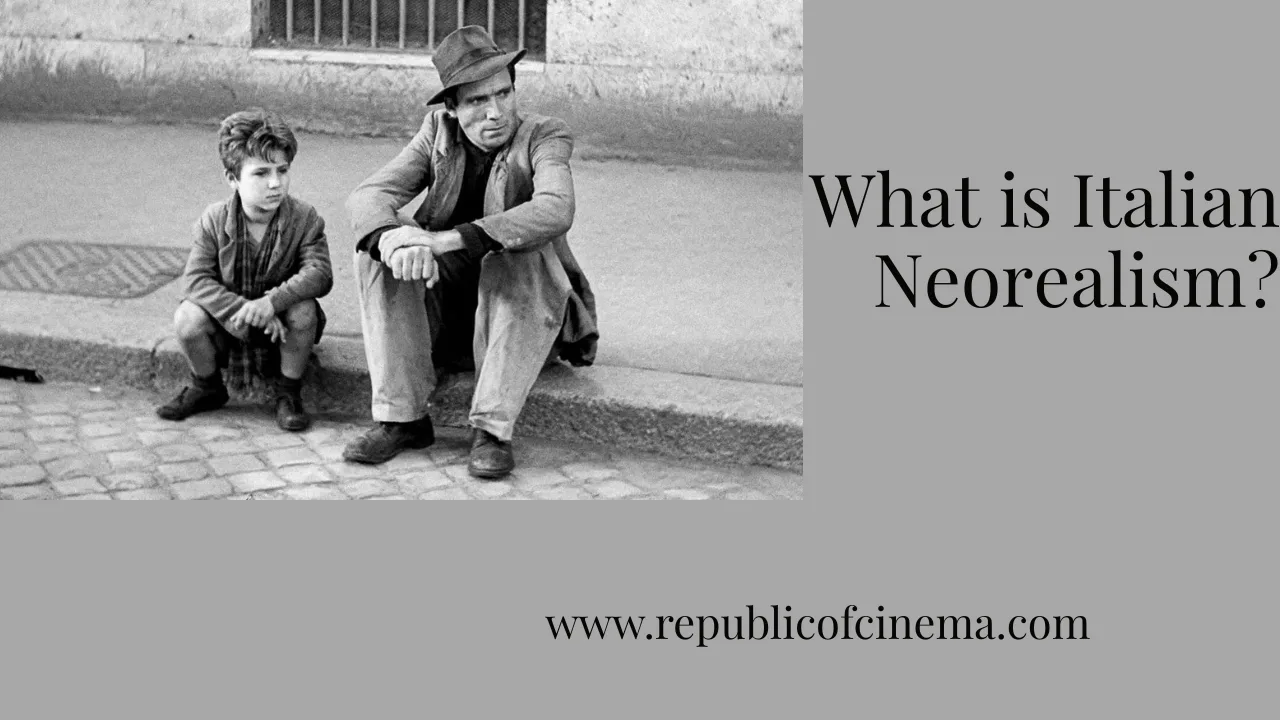
Roberto Rossellini shot the first scenes of Rome Open City in January 1945 with film stock bought on the black market, a camera borrowed from a newsreel company, and actors who were not actors. He did not know he was inventing a movement. He was trying to document something before it disappeared. The document changed cinema permanently.
In the winter of 1944, Rome was under Nazi occupation. Roberto Rossellini, a thirty-eight-year-old Italian filmmaker who had spent the war years making films for the Fascist government — films he was not proud of, films he had made to survive — decided to make a film about what was actually happening in the city around him.
He could not afford a proper studio. He shot in the streets, in actual apartments, in real locations still marked by the occupation. He cast Anna Magnani — a theatre actress with no significant film experience — and Aldo Fabrizi — a comedian — alongside actual members of the Roman resistance. He used whatever film stock he could acquire, which meant that the film's visual texture is inconsistent, sometimes grainy to the point of illegibility, in ways that a studio production would have found unacceptable.
Rome Open City premiered in September 1945, four months after the liberation of Rome. Italian critics were lukewarm. The film looked wrong — too rough, too unglamorous, too obviously shot outside the controlled conditions of a studio. What Italian audiences and critics had been trained to expect from cinema was the white telephone movies of the Fascist era — gleaming, artificial, hermetically sealed from the reality outside the cinema doors.
Rome Open City looked like that reality had walked through the cinema doors and sat down in front of the camera.
What Neorealism was reacting against
To understand what Neorealism changed you must first understand what it was replacing.
Italian cinema under Fascism had developed a specific aesthetic philosophy that was also a political philosophy: cinema should show the world as it should be rather than as it is. Heroes were noble. Spaces were clean. Suffering, when depicted, was dignified. The poor, when they appeared, were picturesque rather than desperate. The camera was always at a comfortable distance from anything that might disturb.
This was not simply aesthetic preference. It was an ideological instruction. A cinema that showed the world as it should be was a cinema that told its audience to accept the world as it was — because the world as it was, dressed up as the world as it should be, appeared on screen as normal, natural, desirable.
Rossellini and the directors who followed him — Vittorio De Sica, Luchino Visconti, Giuseppe De Santis — understood this connection intuitively even if they did not always articulate it explicitly. To make cinema honestly was to make it politically. There was no neutral position. A camera that looked away from poverty was taking a side. A camera that looked away from the specific faces of people living specific difficult lives was taking a side. The question was only which side.
The specific discoveries of Rome Open City
Rome Open City made several discoveries that Neorealism would develop and that cinema has been working with ever since.
The first discovery was that real locations are more cinematically powerful than sets — not because they are more realistic in a simple sense, but because they carry information that no set designer can reproduce. The specific wear on a staircase banister. The specific quality of light through a particular window. The spatial relationship between a kitchen and the street visible through it. These details do not simply make a film look real. They root it in a specific historical moment, making the film a document as well as a story.
The second discovery was that non-professional or semi-professional actors bring something to the screen that trained actors cannot replicate — a specific relationship with their own bodies, a specific quality of presence, that communicates authenticity not because it is artless but because it is differently artful. Anna Magnani's performance in Rome Open City remains one of the greatest in cinema history not despite her theatre background but because Rossellini understood how to use her specific quality of physical and emotional directness in a way the camera could capture.
The third discovery was that editing in Neorealism could be looser, more willing to stay in a scene beyond the conventional dramatic moment, more resistant to the rhythm of classical Hollywood editing that moves always toward narrative efficiency. This looseness — which Italian critics in 1945 read as technical inadequacy — was actually a formal argument: that life does not cut to its most dramatically efficient moment, and a cinema that does so is falsifying the experience it claims to represent.
What changed permanently
The influence of Neorealism on subsequent cinema is so total that it is almost invisible — like the grammar of a language, present in every sentence but noticed only when you deliberately look for it.
Every film that shoots on location rather than on a set owes something to Neorealism. Every film that casts non-professional actors for specific roles owes something to Neorealism. Every film that allows a scene to continue past its conventionally dramatic endpoint owes something to Neorealism. Every film that insists on the specific rather than the representative — on this street rather than a generic street, on this face rather than a type — owes something to Neorealism.
Satyajit Ray saw Bicycle Thieves in London in 1949 and decided to become a filmmaker. The Apu Trilogy would not exist without Neorealism. The Iranian New Wave would not exist without Neorealism. The Romanian New Wave would not exist without Neorealism. The Dardenne Brothers would not exist without Neorealism.
The movement officially lasted approximately ten years — from Rome Open City in 1945 to the mid-1950s when Italian cinema shifted toward the more polished commercial productions that the recovered Italian economy could now finance. But the decade was enough. The discoveries made in those ten years became part of the permanent vocabulary of serious cinema everywhere.
Rossellini did not know, in January 1945, that he was making a film that would change cinema. He was trying to document something true before it could be falsified. That impulse — the refusal to falsify, the insistence on the specific texture of actual life — is the most important thing Neorealism gave to cinema. Every film that inherits it, whether it knows the inheritance or not, is a better film for having it.
By Republic of Cinema · Cinema History · Cinema Studies · World Cinema · Cinema Movement · Republic of Cinema
💬 Discussion
0 comments