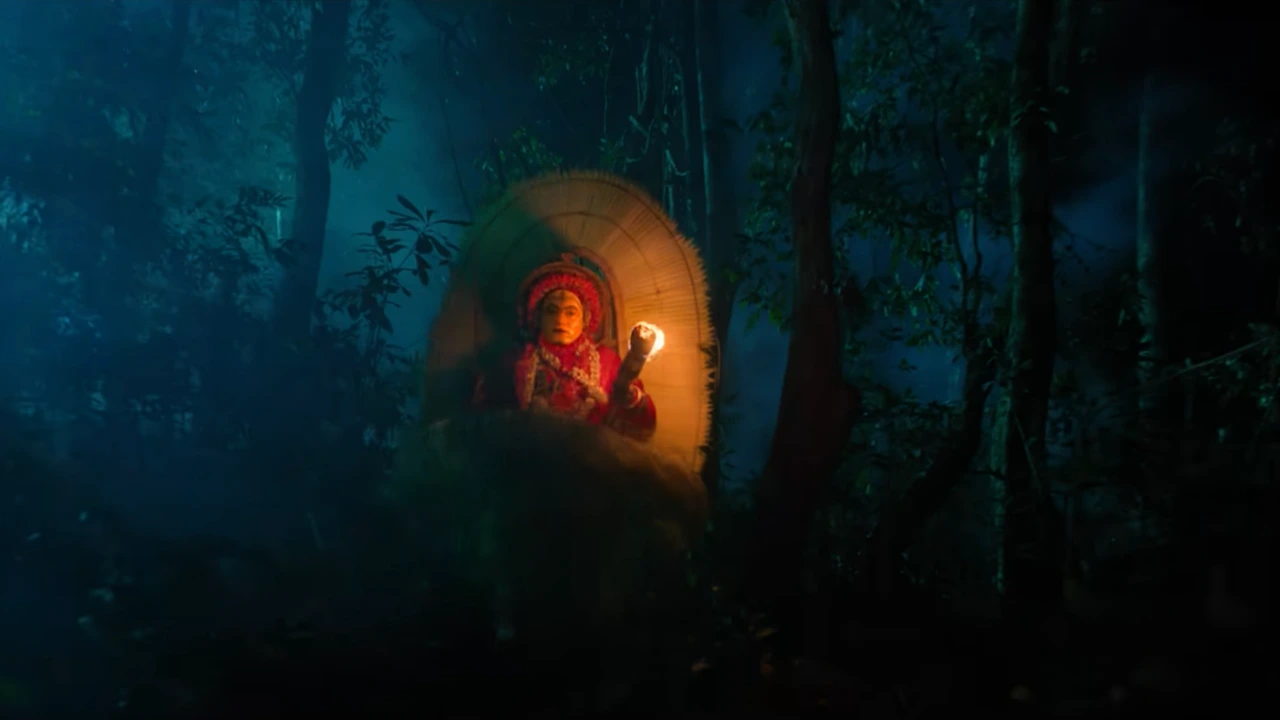
There is a sound in "Kantara" that I have not been able to shake. It is a cry, a long rising vowel that seems to begin in the stomach and end somewhere up in the trees, and it is not quite human. We first hear it in the prologue, coming out of the forest at night, and we understand that it belongs to the god. We hear it last in the film's closing passage, when it comes out of the hero, and we understand that something has changed hands. Everything in between is a long wait for the moment when the man can no longer tell where he ends and the god begins.
Rishab Shetty wrote and directed "Kantara" and plays its lead, and he has made a film about a ritual in which a man becomes a god for one night. The ritual is the Bhoota Kola of Tulu Nadu, the coastal belt of Karnataka. In the film it serves as spine, theology and legal system all at once. "Kantara" never asks whether the god is real; the villagers settled that long ago. It asks what happens to the people who must carry him.
The film opens in 1847, in the manner of a legend told to children. A king who has a kingdom, a devoted wife and children cannot find peace. He wanders until he comes upon a stone in the forest, the seat of Panjurli, the boar spirit who protects the forest people. He wants the stone, and in exchange he offers the villagers a large portion of his land. Speaking through a human medium, the spirit accepts, and adds a warning: its companion, the ferocious Guliga, does not forgive a broken promise.
Then we are in 1970. The king's descendant wants the land back. He confronts Annappa, the Kola performer (also played by Shetty), in the middle of the ritual, while Panjurli is upon him, and asks a lawyer's question: is this the man talking, or the god? Annappa answers with a wager. If he is only a man, he says, he will return. If he is the god, he will not. Then he runs into the dark, anklets ringing, and vanishes into a ring of fire. He is never seen again. The descendant, who has taken his claim to the courts, dies on the courthouse steps.
I describe the prologue in detail because it holds the whole film in miniature, and because it is staged with a confidence that should have told audiences in September 2022 that they were in the hands of someone who knew exactly what he was doing. Notice the two venues. The dispute over the land is heard twice, once at the Kola, where the god presides, and once in the court of the state. The god's verdict arrives first, and it is the one that sticks.
The main story takes place in 1990. Annappa's son Shiva has grown into a magnificent wastrel, a Kambala champion who races buffaloes through flooded paddy, hunts in the forest, drinks with his friends and picks fights for sport. He refuses to perform the Kola, and the duty has passed to his cousin Guruva. He wants nothing to do with the god, because the god took his father. Into this village comes Murali (Kishore), a forest officer ordered to turn the villagers' land into a reserve, who sees no reason why a government survey should bow to a spirit. Presiding over everyone, smiling and generous, is Devendra Suttooru (Achyuth Kumar), the landlord, the king's descendant, patron of the Kola and friend of the poor.
You will guess who the villain is long before the film admits it, and the film knows you will. Achyuth Kumar plays Devendra with a soft voice and a hospitable face, which is the most dangerous thing a landlord can wear. Kishore spends much of the film as an obstacle, but he plays Murali as a man of conviction rather than a bully, and the screenplay rewards him with a late turn that he has earned. Sapthami Gowda's Leela, a village girl whom Shiva helps into a forest guard's uniform, stands between that uniform and her own people. That is a rich dilemma, and the film mostly declines to explore it. Critics at the time found her underwritten, and they were right.
I should be honest about the first two-thirds of "Kantara." Much of it is a conventional Kannada mass entertainer, with a rowdy gang of friends, broad comedy, a courtship that has not aged gracefully, and fights shot in slow motion with the hero's chest thrust toward the camera. The writing circles the quarrel between Shiva and Murali more than once without deepening it. Someone who wandered in for an hour in the middle might wonder what the fuss was about. These are real complaints, and they are why I stop short of four stars.
Even here, though, Shetty is laying wires. The Kambala race that introduces Shiva, which Arvind S. Kashyap films low and drenched, with men and buffaloes ploughing through the slush, is a portrait of a body that does not yet know what it is for. Shetty trained for four months to run that race himself. The hunting, the drinking, the brawling are energy without a destination. When the destination arrives, we see that the film has been showing us the vessel before the god is poured into it. Kashyap's night photography, all torchlight and smoke and wet leaves, and B. Ajaneesh Loknath's score, built from folk instruments and the harvest songs of the region, do much of the work of keeping the sacred in view while the plot is busy with fistfights.
A word on the tradition, for readers outside Karnataka. In Tulu, "bhoota" does not carry the sense of a ghost that it does in Hindi; it is used in the same sense as "daiva," a divine spirit. "Kola" is the performance, which runs from dusk to dawn. The performer, painted and costumed, is understood to be possessed, and the daiva then speaks through him, blessing and scolding and settling disputes over land, water and family. Folklorists describe it as part ritual, part theatre and part social conscience. Panjurli, the boar, guards the crops and the community. Guliga is the enforcer, the one who punishes when the balance is broken. Local lore holds that the two once fought over the same land before making peace.
This is what lifts "Kantara" above a revenge drama with folk decoration. Its three central figures stand for three rival claims over the same forest. Murali speaks for the modern state and its maps. Devendra speaks for the old feudal order, which wears the clothes of piety and patronage. And the daiva speaks for the land itself, and for a covenant older than either. The film is not neutral among them, but it is fair to Murali, which is more than many films of its kind manage.
Beneath it all runs an idea of debt. Indian thought has an old word for it, ṛṇa: what a person owes simply by being born, to the gods, to the sages, to the ancestors. Shiva's refusal to dance is a debt left unpaid to his father. The king's bargain is a debt the land has carried for a century and a half. Devendra's crime is an attempt to default on it, and the film is precise about the form his crime takes. He offers Guruva money to fake the possession at the next Kola and make Panjurli order the villagers to surrender their land. Guruva refuses, and is murdered for it. Of all the sins in "Kantara," the one it cannot forgive is counterfeiting the god.
And so to the climax, which is the reason the film exists and the reason it will be watched for a long time.
Devendra's men attack the village at night. People die. Shiva, beaten and bleeding, falls and strikes his head against Guliga's sacred stone, and something enters him. Shetty plays it as an invasion. The posture changes first: the spine bends, the shoulders gather, the head tilts at an animal angle. The eyes stop focusing on faces and begin to look through them. His face is caked in black mud, and what follows has the shape of a fight but the logic of a rite, a sentence being carried out on the bodies of the guilty. The hero has gone missing from his own body, and the camera seems a little afraid of whatever is wearing it.
Then, months later, comes the second movement, and this is the one I think about most. Shiva performs the Kola at last. He is costumed as Panjurli, his face painted in the colours of the boar spirit, the towering frame of the costume rising behind him. The fury of Guliga has gone, and in its place is something like a terrible tenderness. The god, through Shiva, takes the hand of Murali, the officer of the state, and joins it with the hands of the villagers. It is a covenant, made in the only court the film entirely trusts. Then Shiva sees, or seems to see, his father's spirit at the edge of the forest. He goes after him into the dark, as his father once did, and he does not come back. In a brief coda, a small boy asks where his father went.
What Shetty does in these final minutes rests on a great deal of preparation. He told The Week that he watched at least a thousand videos of Bhoota Kola performances and spent time with the daiva narthakas, the hereditary performers, so as to get it right; he gave up meat, walked barefoot through the shoot, and fasted on the days the Kola was filmed. He began as a performer in Yakshagana plays in Kundapura, and the training shows in the way he holds a pose a beat longer than seems possible and then lets it go. The Kola passages were choreographed by his co-writer Raj B. Shetty, who grew up watching the ritual. Yet the effect on screen has little to do with skill. We seem to be watching a man who has lent his body to something and is waiting, from somewhere far inside, to see what it will do with it. I have seen great performances of madness and of grief. I have rarely seen a performance of being occupied.
The cry returns here, now from Shiva's own throat, and it is the sound of a self being emptied out.
The Nāṭyaśāstra, the ancient treatise on drama, gives us language for what happens to an audience in these scenes. For most of its length "Kantara" trades in vīra, the rasa of heroism, and hāsya, the comic. The Guliga sequence reaches raudra, the rasa of fury, whose root emotion is anger, and shades into bhayānaka, terror. The Panjurli Kola reaches for adbhuta, the rasa of wonder. And at the very end, as the man walks away from the firelight, I think the film touches śānta, the stillness that the philosopher Abhinavagupta argued was the rasa in which all the others come to rest. That is a remarkable arc for a film that an hour earlier was staging a drunken brawl. I can think of no other recent Indian blockbuster that ends in stillness.
The nearest relative to this climax in Indian cinema may be Jayaraj's "Kaliyattam" (1997), which set "Othello" in the world of Theyyam, the Kerala cousin of the Bhoota Kola, and won Suresh Gopi the National Award for Best Actor as a Theyyam performer undone by jealousy. Further back, on the same coast, is B. V. Karanth's "Chomana Dudi" (1975), from Shivarama Karanth's novel about Choma, a Dalit bonded labourer in coastal Karnataka whose only wish is to till land of his own. It won the Swarna Kamal for Best Feature Film. "Kantara" is a louder and far more devout film, but it is asking Choma's question: who may own the land, and who decides? And the film that comes to mind most often during the possession scenes is a documentary, Jean Rouch's "Les Maîtres Fous" (1955), which recorded spirit possession in the Gold Coast and still unsettles audiences seven decades on. Rouch filmed men becoming spirits from the outside. Shetty, with all the advantages and risks of fiction, films it from within.
How the film reached its audience is part of its meaning. Shetty grew up in Keradi, a village in the Kundapura taluk, and has said the story was drawn from the friction between forest officials and villagers there in the 1990s. Before he made films he worked odd jobs, supplying water cans among them, while trying to find a way in. He had already won a National Award for the children's film "Sarkari Hi. Pra. Shaale, Kasaragodu, Koduge: Ramanna Rai" (2018). He conceived "Kantara" during the lockdown of 2021, shot it in and around his own village, and drew his extras from Kundapura; his wife Pragathi Shetty, who designed the costumes, has described having to persuade them to wear the tribal dress. The budget was about ₹16 crore.
The film opened in Kannada on 30 September 2022 in a little over 250 theatres across Karnataka, and the trade expected modest returns. Then word of mouth did what it seldom does anymore. Dubbed versions followed in Hindi, Telugu, Tamil and Malayalam and, after a campaign by Tulu speakers, in Tulu, the language of the tradition the film depicts. By the end of its run "Kantara" had grossed in the region of ₹400 crore worldwide and sold more than a crore of tickets in Karnataka alone, and the Government of Karnataka had announced a monthly allowance for daiva narthakas over the age of sixty. That last fact is the one I keep coming back to. A film about a ritual changed the material lives of the people who perform it. Very few films can claim as much.
The film won the Special Jury Award, a Silver Peacock, at the International Film Festival of India in 2023, and at the 70th National Film Awards, announced in 2024, Shetty won Best Actor and "Kantara" was named Best Popular Film Providing Wholesome Entertainment. Afterward Shetty told PTI that he would not be making "festival type" films any more, because such films do not recover their costs. It is a practical man's answer, and "Kantara" is a practical man's film. It uses the machinery of the mass entertainer to carry something that machinery was never designed to hold.
There were disputes. The film's most beloved song, "Varaha Roopam," drew a copyright suit from the Kerala band Thaikkudam Bridge, who said it copied their 2015 song "Navarasam"; the case was closed in 2023 after the parties settled, and the original track was restored. A deeper argument was about faith. Shetty said in an interview that the daivas belong to Hindu culture, and the film presents Panjurli in the image of Varaha, the boar avatar of Vishnu. The actor and activist Chetan Ahimsa, along with several Tulu scholars, argued that the Bhoota Kola is an older, indigenous practice that should not be folded into Brahminical Hinduism; complaints were filed against Chetan with the police for saying so. Kishore, the film's forest officer, posted a reply of his own, asking people not to paint the bhoota and the daiva in a single colour, and asking why those quarrelling over the ritual were not troubled by the untouchability still practised against the very people who perform it.
I am not a Tuluva, and it is not for me to settle where the Kola belongs. But Kishore's question sheds light on the film. The performers who become gods for a night return in the morning to a social order that has long kept them at its edges. "Kantara" understands this. Devendra's courtesy toward the villagers is a performance too, and the film lets us see behind it. Whatever its theology, its sympathies lie with the people who carry the god, not with those who would rent him. It is a believer's film, made from inside a faith, and that is both the source of its power and the reason it cannot be the last word on its subject.
In 2025 Shetty returned with a prequel, "Kantara: Chapter 1," which reaches back centuries to the origins of the myth and earned, by its producers' count, more than ₹800 crore, a figure the 2022 film could not have dreamed of. A further chapter has been announced. Whatever the franchise becomes, the first film will remain the one in which a god arrived without warning, in a modest Kannada picture made in a village in Kundapura, and found a country waiting for him.
I keep returning to those last minutes. The clearing at night, lit by torches. The painted figure with the great frame rising at its back. The officer's hand placed in a villager's hand by a god who will not stay to see whether the promise is kept. Then the man turns away from the firelight and walks toward the trees, the bells at his ankles growing fainter, until there is only the forest, and the cry rising once more out of the dark, belonging to no one we can name.
💬 Discussion
0 comments