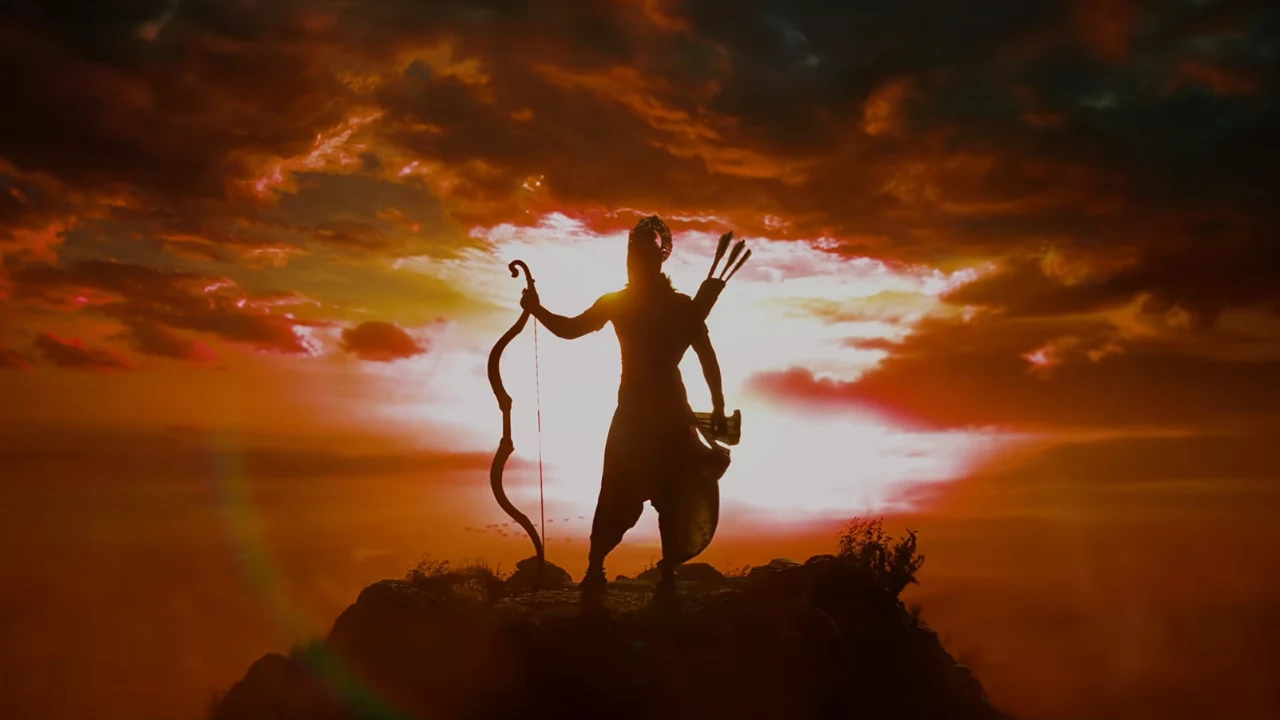
At several IMAX screens in India, a first-day seat for Ramayana: Part 1 now costs more than ₹2,000, and those are the seats selling fastest. The story on that screen first reached most Indian homes for free. Ramanand Sagar’s Ramayan (1987–1988), the Doordarshan serial in which Arun Govil played Rama, turned a Sunday-morning broadcast into a national ritual. Govil returns in Nitesh Tiwari’s film as Dasharatha. Nearly four decades later, the same epic is being sold first as the most expensive seat in the house.
The demand is now measurable. By 9 a.m. on Sunday, October 25, the film had sold 1,07,562 tickets at India’s two national multiplex chains, 96,645 at PVR INOX and 10,917 at Cinepolis, according to trade figures. Tracking across a wider set of screens put India pre-sales at ₹10.67 crore gross by Saturday night including block-booked seats, or ₹8.45 crore without them, across 4,516 shows. Bookings opened on Dussehra, October 20. The film opens worldwide on Thursday, November 5, in Hindi, Tamil, Telugu, Kannada and Malayalam.
What those sales are made of says more than their size. The breakdown attributes 31 per cent of the gross to IMAX, 4DX, Dolby and other premium formats, which account for only 322 shows, roughly one in every fourteen. IMAX 3D is running at 51 per cent occupancy, the highest of any major format, and 3D screenings of every kind make up nearly two-thirds of the money. Audiences are not merely booking Ramayana early. They are choosing the version of it that costs the most.
“Audiences are not merely booking Ramayana early. They are choosing the version of it that costs the most.”
A Release Built for the Biggest Screen
That is the release working exactly as designed. “I believe Ramayana should be experienced on the biggest screen possible, in IMAX 3D,” the producer Namit Malhotra said this week, announcing the film’s streaming arrangement with JioHotstar. The strategy reaches beyond IMAX. In August, a deal with CJ 4DPLEX was reported to place the film in close to 1,300 ScreenX and 4DX auditoriums worldwide, making it the first Indian film released in ScreenX.
Even the film’s afterlife is priced as an event. JioHotstar and Malhotra’s Prime Focus Studios will offer it on a pay-per-view basis in India once the theatrical run ends, rather than folding it into a subscription; neither the length of that window nor the price has been disclosed. A subscription release would have made Ramayana one title among thousands. Pay-per-view keeps a price on it, even at home.
The arithmetic explains the insistence. Malhotra said in a 2025 podcast interview that the production would come to “about $500 million by the time we’re done, on both films put together.” Yash, who plays Ravana and co-produces through his Monster Mind Creations, later clarified in a television interview that the widely quoted ₹4,000 crore “includes both the films, and the promotional costs.” On either reading, it is by a wide margin the largest budget announced for an Indian production. No single market, at ordinary ticket prices, could pay it back.
A Map of Shared Risk
The risk has been divided territory by territory. Dharma Productions is releasing the film in the Hindi-speaking markets. Dil Raju’s Sri Venkateswara Creations has Andhra Pradesh and Telangana, Monster Mind Creations has Karnataka, and Think Studios and E4 Entertainment have been reported for Tamil Nadu and Kerala. Outside India, Sony Pictures is releasing the film as Ramayana: Rise of a Legend, a title that offers foreign audiences an origin story rather than a scripture.
The early pre-sales show how unevenly that map is lit. Hindi accounts for 87 per cent of tracked pre-sales. Kannada has contributed ₹1.06 crore from 319 shows, a strong early return in Yash’s home state, where his own banner is the distributor. Telugu bookings are open at only 50 shows, and Tamil and Malayalam have yet to open at scale. Any national figure quoted this week is, in practice, a Hindi figure with a Kannada accent.
The Thursday Before Diwali
The date itself took weeks to settle. When the two-part plan was announced in November 2024, Malhotra wrote: “Part 1 in Diwali 2026 and Part 2 in Diwali 2027.” International marketing for the overseas version later carried November 6. On October 11, the first day of Navratri, the makers fixed November 5 worldwide with a new ensemble poster and the line “Yeh Ram ke Yug ka Aarambh hai” (this is the dawn of Rama’s age). Sony’s own listings now give November 5. Trade reports of roughly 300 paid previews on November 4 have not been confirmed by the makers.
Opening on a Thursday, three days before Diwali on November 8, is a deliberate trade. Trade analysts caution that the days before the festival can cap national-chain sales, with the holiday peak arriving only after Diwali itself. The film gives up the cleanest possible first day in exchange for a run that starts ahead of the festival and is then carried by it.
What the Trackers Expect
The projections cluster around the same number, though not the same measure. Trade expectations centre on a ₹70 crore opening, with ₹60 crore seen as the figure that would keep the film in the race and anything above 3.5 lakh opening-day tickets at the national chains counted as a good result. A separate trade forecast puts the Hindi version’s first day at ₹68 crore to ₹78 crore net. These are estimates built on different methods, and published pre-sales totals already diverge by close to ₹2 crore depending on the tracker and the hour.
None of these numbers can measure what will decide the run. Om Raut’s Adipurush (2023) also arrived as a large-format retelling of the epic, and saw its fortunes collapse within days under criticism aimed at its visual effects and its dialogue. Mythological cinema plays to an audience that knows every turn of the story before the lights go down. It cannot surprise that audience with plot. It can only persuade it with images, performances and tone, and that verdict is delivered on the first night.
The Ensemble and the Score
Ranbir Kapoor plays Rama and, as he confirmed in April, Parashurama, an earlier avatar of Vishnu. Sai Pallavi is Sita, Sunny Deol is Hanuman and Ravi Dubey is Lakshmana. Around them, the trailer confirmed Lara Dutta as Kaikeyi, Kajal Aggarwal as Mandodari, Rakul Preet Singh as Shurpanakha and Vivek Oberoi as Vidyutjihva, with Anupam Kher voicing Jatayu.
Hans Zimmer and A. R. Rahman share the score. This morning T-Series released “Mangal Rang,” a Rahman composition with lyrics by Kumar Vishwas, sung in Hindi by Arijit Singh and Shreya Ghoshal and issued in all five languages over images of Rama and Sita’s wedding and exile. It follows Ravana’s anthem, released around Dussehra as “Rise of Asura” in Hindi, with vocals by Vishal Dadlani, and as “Ravana Tandava” in Kannada. The campaign has now put both of its registers on sale, devotion and spectacle, a week apart.
Part 2, Reportedly Delayed
The sequel’s date is the one now in question. A trade report this week, citing an unnamed source, said Ramayana: Part 2 may move from Diwali 2027 to Diwali 2028: the second film, which carries the war, needs more shooting time, its action design has taken longer than planned, and Malhotra intends to enlarge its scale. The makers have neither confirmed nor denied the report.
Whatever happens to the sequel, the first film’s date is fixed, and so is its bargain. Tiwari’s Ramayana asks Indian audiences to pay the highest price the multiplex charges for a story they have known since childhood, and the early pre-sales say a great many are willing. What those numbers cannot say is whether the film will feel worth the seat. A country that once watched this epic together on a single Sunday-morning channel will settle that question on one night, November 5, and will have told itself the answer by morning.
💬 Discussion
0 comments