The Romanian New Wave Came From One of the Most Repressive Political Regimes in European History — Here Is Exactly How Oppression Created Precision, and Why Romanian Cinema Became the Most Formally Rigorous Cinema in the World
Between 2001 and 2012 a group of Romanian filmmakers — working with minimal budgets, minimal international recognition, and maximum creative freedom — made the most formally rigorous and morally serious body of cinema produced anywhere in the world in the first decade of the twenty-first century. Understanding how and why requires understanding the specific historical conditions that produced them.
The Ceaușescu regime ended in December 1989 with the dictator's execution after twenty-four years of one of the most systematically repressive governments in Eastern European history. By the time the regime fell, Romania had been so thoroughly impoverished — by Ceaușescu's insistence on repaying all foreign debt, which required the export of most of the country's food and energy production — that ordinary Romanians were living without heat, without adequate food, without basic consumer goods.
The film industry during this period was state-controlled and state-funded, which meant it was used primarily for propaganda. Romanian cinema before the fall of communism has its moments of genuine quality — Lucian Pintilie's films in particular — but the systemic conditions of state control produced a cinema that was either officially sanctioned or suppressed.
The generation of filmmakers who emerged in the 2000s grew up under communism, came of age in the chaotic transition period of the 1990s, and made their films in the early years of Romanian democracy. They shared a set of experiences — of life under a system built on systematic dishonesty, of transition from one form of deprivation to another, of a society learning slowly and painfully what it meant to be free after decades of enforced conformity.
These experiences produced a specific set of aesthetic choices that, when they emerged simultaneously across several filmmakers who had not coordinated them, constituted a movement.
The aesthetic principles of the Romanian New Wave
The Romanian New Wave is not a manifesto movement. Its filmmakers did not sign documents or publish theoretical positions. What they share is a set of formal commitments that emerged independently from their shared experience and that, viewed together, constitute a coherent aesthetic philosophy.
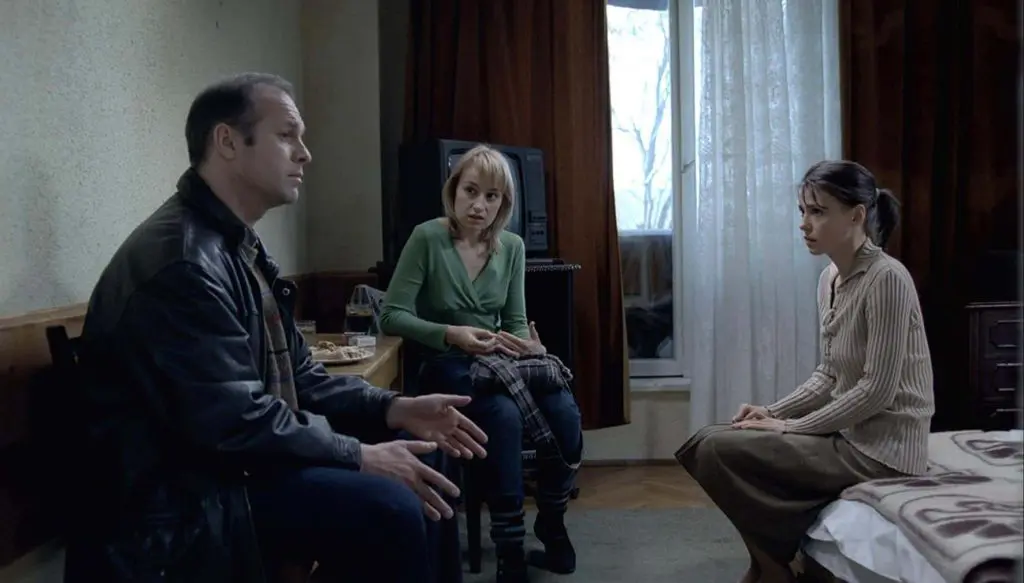
The long take as moral position. Romanian New Wave films are built around extended, unbroken shots of extraordinary duration. Cristi Puiu's The Death of Mr. Lazarescu uses takes that last minutes at a time. Corneliu Porumboiu's 12:08 East of Bucharest holds its central scene — three men discussing whether the Romanian revolution actually happened in their town — in a single, largely unmoving frame for extended periods.
This commitment to the long take is not simply a formal preference. It is a moral position — the refusal to cut away from discomfort, from boredom, from the specific texture of time passing in a way that does not resolve. Romanian society under communism was built on the systematic falsification of reality — on official accounts of events that did not correspond to anyone's actual experience. The long take is the formal equivalent of refusing that falsification: staying with what is actually happening until its full moral weight has been registered.
The refusal of emotional direction. Romanian New Wave films refuse to tell you how to feel. There is no score providing emotional cues. There is no editing rhythm directing your attention to what is most significant. The camera watches without commenting. What you feel is your response to what is actually there — not a response produced by the film's manipulation of your emotional system.
This refusal is a political position as much as an aesthetic one. A cinema that tells its audience how to feel is a cinema that is managing its audience's relationship with reality — producing the emotions that serve the film's argument rather than the emotions that the situation itself generates. After decades of a regime that managed its citizens' relationship with reality — that told them how to interpret events, what to think about their own experience, what emotions were appropriate — Romanian filmmakers made cinema that refused to perform the same function.
The specific comedy of specific discomfort. The Romanian New Wave is frequently genuinely funny — not in the sense of being amusing, but in the sense of producing the specific kind of laughter that occurs when something true is said about a situation that is simultaneously painful and absurd.
Corneliu Porumboiu's films are the most purely comic expression of this. Police, Adjective is a film in which a detective refuses to arrest a teenager for smoking cannabis because he does not believe the law is morally justified. His superior officer makes him look up the words police and conscience and moral in a Romanian dictionary to argue that a police officer's conscience is the state's conscience. The scene is genuinely funny and genuinely horrifying in equal measure. The comedy and the horror are inseparable — the laughter is the recognition of absurdity that would otherwise be simply terrible.
The key films — in recommended order
The Death of Mr. Lazarescu (2005) · Cristi Puiu The founding document of the movement. An elderly man is taken from hospital to hospital across a single night. The system fails him systematically, without malice. Two and a half hours of real time that produce the most complete portrait of institutional indifference in cinema.
12:08 East of Bucharest (2006) · Corneliu Porumboiu A small-town television host asks whether the revolution happened in his town before or after Ceaușescu fled. The question becomes a meditation on memory, self-deception, and the relationship between small lives and historical events.
4 Months, 3 Weeks and 2 Days (2007) · Cristian Mungiu Palme d'Or winner. The most formally rigorous film of the movement. An illegal abortion in communist Romania filmed with a precision that makes the moral weight of the situation physically present in the viewer.
Police, Adjective (2009) · Corneliu Porumboiu A detective refuses to arrest a teenager. The film is about the relationship between language, law, and conscience — and it is the funniest serious film since Dr. Strangelove.
Tuesday, After Christmas (2010) · Radu Muntean A man is having an affair. His wife does not know. The film watches the situation unfold in long takes of extraordinary intimacy that produce the most uncomfortable and most honest film about marital infidelity in cinema history.
Beyond the Hills (2012) · Cristian Mungiu Two young women at an Orthodox monastery. The film refuses to assign blame — neither the religious community nor the state nor any individual is simply wrong. Everyone is following their logic to conclusions that together produce catastrophe.
What the Romanian New Wave means for Indian cinema
The Romanian New Wave is relevant to Indian cinema not as a model to be imitated but as a proof of a principle that Indian independent filmmaking needs to hear.
The principle: the most formally ambitious and the most morally serious cinema does not require large budgets, established stars, or institutional support. It requires filmmakers who know exactly what they are doing and why — who have worked out their formal philosophy in relation to their specific historical and cultural experience and who execute that philosophy with complete consistency.
Romanian cinema has a fraction of India's resources and a fraction of India's filmmaking history. It produced, in a single decade, a body of work that changed the international understanding of what contemporary cinema could be. India has the resources, the history, the talent, and the subject matter. The question of why Indian cinema has not produced an equivalent movement is the most important unanswered question in Indian film culture.
The Romanian New Wave did not happen because Romanian filmmakers had advantages. It happened because they had clarity — about what their cinema needed to be, about what their historical experience demanded, about what formal choices would make that experience fully visible. That clarity is available to any filmmaker regardless of resources. It requires only the courage to identify it and the discipline to serve it.
💬 Discussion
0 comments