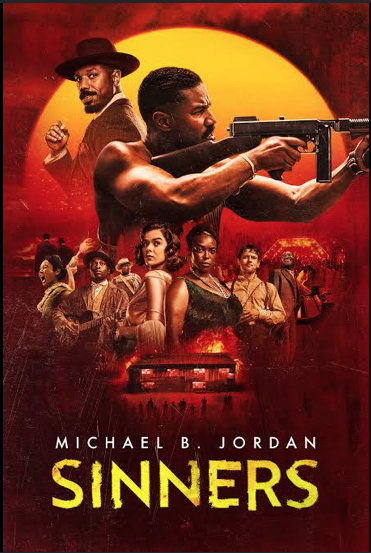
Sinners 2025
Sinners 2025 Is the Most Formally Ambitious American Film in Years — and Ryan Coogler Has Finally Made the Film He Was Always Capable Of
It begins as a period blues film, becomes a horror film, and ends as something that has no genre name yet. What holds it together is not plot or spectacle but a complete philosophical argument about Black American creativity — where it comes from, what it costs, and what forces have always tried to consume it.
There is a moment approximately forty minutes into Sinners where a juke joint in 1932 Mississippi fills with music and the camera begins to move and time begins to dissolve — the past bleeding into the present, the future bleeding into the past, the dead dancing with the living — and you realise that Ryan Coogler is not making the film you thought he was making. He is making something larger and stranger and more personal than anything in his previous work. He is making a film about what music is, where it goes when it enters a body, and why certain forces in the world have always wanted to possess it rather than simply destroy it.
The film follows twin brothers Smoke and Stack, both played by Michael B. Jordan in a performance that requires him to be two completely different people sharing one face, returning to their Mississippi hometown after years away. They pool their money to open a juke joint. On opening night, something arrives at the door that wants to come inside.
What arrives is a vampire. But explaining Sinners as a vampire film is like explaining Apocalypse Now as a war film. The genre is the container. What is inside the container is the argument.
Coogler's argument is this: Black American music — blues, jazz, gospel, and everything that descended from them — is the most powerful creative force in American cultural history. It emerged from suffering of a specific and historical kind. Its power comes precisely from that origin. And the forces that have always wanted to own it, commodify it, extract it from the bodies and communities that created it, are not metaphorically vampiric. They are actually vampiric. They take the life force and leave the husk.
This is not a subtle argument. Coogler does not make subtle films. But in Sinners he makes it with a formal sophistication his previous work has gestured toward without fully achieving. The film's visual language is built around containment and release — tight interiors suddenly opening into vast exteriors, close-ups held long past the point of comfort until a face becomes a landscape, darkness broken by light that seems to come from the music itself rather than from any practical source. Autumn Durald Arkapaw's cinematography is the best work of her career and one of the great American film images of recent years is hers: Michael B. Jordan standing in a field at dawn, the Mississippi light coming across the cotton, the past and present simultaneously visible in his face.
The horror sequences work because Coogler has earned them. By the time the juke joint is under siege the film has built such a specific and populated world — you know these characters, their histories, their relationships, their small dignities and griefs — that the threat to them is genuinely terrifying in the way that only horror that has done its human work first can be genuinely terrifying. The Overlook Hotel is frightening because Kubrick spent ninety minutes making you feel its specific psychic weight. The juke joint in Sinners is frightening for the same reason.
Michael B. Jordan's dual performance deserves its own essay. Smoke and Stack share a face but nothing else — different gaits, different relationships with silence, different ways of occupying a room. Jordan achieves the distinction through physical intelligence rather than prosthetics or makeup — it is a performance of the body, of how a person carries their history in the way they stand. That he makes two fully inhabited people from one face is the kind of acting achievement that gets discussed for years.
The film is not perfect. The third act slightly overstays its welcome and there are moments in the middle section where the pacing slackens in ways that feel like uncertainty rather than intention. But these are minor complaints about a film that is doing something genuinely ambitious and largely achieving it.
What Sinners ultimately is — beneath the genre, beneath the music, beneath the spectacle — is a film about Black American creative genius as a form of spiritual power, and about what happens when that power is recognised and coveted by forces that cannot create but can only consume. It is a horror film about cultural appropriation in the most literal possible sense. It is also, in its final image, a film about survival — about what persists when everything that can be taken has been taken.
Ryan Coogler has been one of the most talented American filmmakers of his generation for a decade. Fruitvale Station announced him. Black Panther confirmed his commercial authority. Sinners is the film where the talent and the authority and the personal vision finally come together into something irreducible. It is the film he was always capable of.
💬 Discussion
0 comments