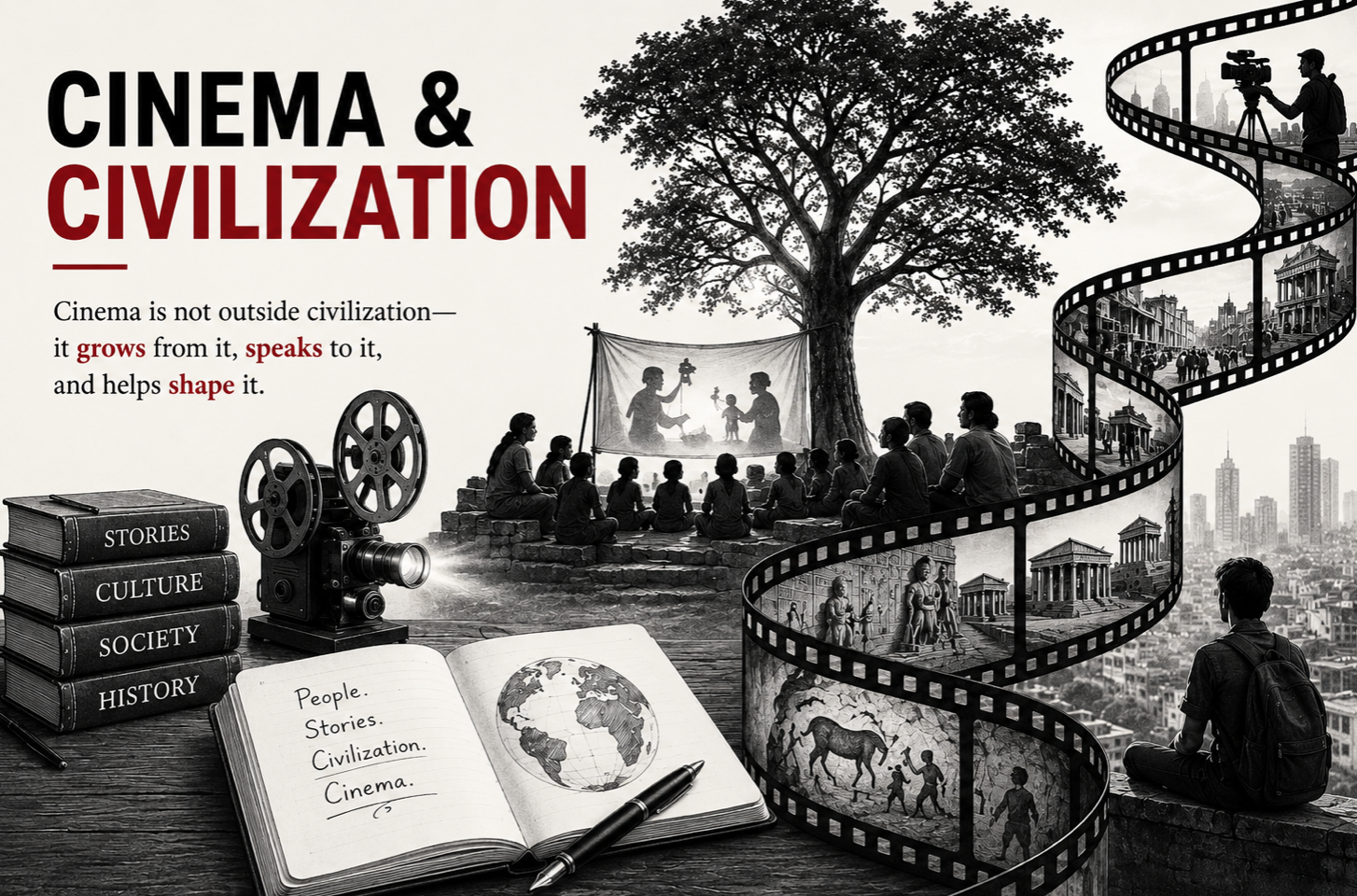
Cinema Is a Hundred and Thirty Years Old and Has Already Changed What Human Beings Remember About the Twentieth Century More Completely Than Any Other Force — Including the Historians
The First World War is not what actually happened in the trenches of the Western Front between 1914 and 1918. It is what All Quiet on the Western Front, Paths of Glory, and Apocalypse Now have made it into — which is a different thing, a constructed thing, a thing shaped by three filmmakers' moral visions. We know this and it does not change how we remember. That is the most extraordinary fact about cinema's relationship with civilisation.
There is a scene in Paths of Glory where three French soldiers are executed for cowardice. They did not commit cowardice. They retreated from an attack they were ordered to make, an attack that was suicidal, an attack that their commanding officers knew was suicidal and ordered anyway for reasons that had nothing to do with military strategy and everything to do with career advancement.
The execution is filmed by Kubrick with a formality that is also a condemnation — the camera at a respectful distance, the ceremony of military execution rendered with its own ghastly dignity. The soldiers are blindfolded. One is unconscious and must be propped up. The rifles fire. They fall.
This scene did not happen. These men did not exist. The film is based on a novel which was based on actual events but is not a documentary reconstruction of those events. Kubrick invented the specific details of the execution, the specific faces of the condemned men, the specific quality of light on that specific morning.
And yet this scene is more present in the memory of the First World War for the millions of people who have seen it than any equivalent passage in any history book about the actual courts-martial that occurred on the Western Front. It is more emotionally available. It is more easily recalled. It has done more to shape the moral understanding of what the First World War was than the historical record it is based on.
This is cinema's most extraordinary civilisational capacity and its most terrifying one.
How cinema constructs historical memory
Human memory does not work like a filing system. It works like a construction site — memories are rebuilt each time they are recalled, incorporating new information, new emotional associations, new contextual understanding. The rebuilt memory feels like retrieval but is actually reconstruction.
This means that the images we have encountered — in films, in photographs, in dreams — are incorporated into our memories of events we did not witness, as if we had witnessed them. A person who has seen Schindler's List and reads subsequently about the Holocaust is not reading with a blank mind. They are reading with a mind that contains Spielberg's visual language, Spielberg's moral framing, Spielberg's decisions about what to show and what to withhold. Those decisions shape what the historical text means to them in ways they cannot fully detect or correct for.
This has happened at the civilisational level. The Second World War in Western popular consciousness is substantially the Second World War as Hollywood constructed it — a war of clear moral polarity, heroic sacrifice, and ultimate justification. The complexity, the complicity, the crimes committed by the Allied powers that the dominant cinema narrative either omits or minimises — these do not have the same status in collective memory because they have not been given the same cinematic form.
The Holocaust is remembered, in the West, primarily through the lens of survivor testimony and fictional cinema — Schindler's List, Life is Beautiful, Son of Saul. Each of these films makes specific moral and formal choices that shape not just how the Holocaust is remembered but what lessons are drawn from it, whose experience is centred, whose is marginalised. The Sonderkommando who is the protagonist of Son of Saul — a prisoner forced to assist in the operation of the gas chambers — is a radically different moral figure from Oscar Schindler. His experience of the Holocaust is radically different. His prominence in one film and near-absence from the others is itself a moral argument about which experiences of the Holocaust cinema has chosen to make legible.
Cinema and the construction of national identity
Every nation that has a cinema has used that cinema to construct a version of its own history that serves the purposes of national identity — emphasising certain events, certain figures, certain moral lessons, while minimising or omitting others.
American cinema has constructed an America that won the Second World War through individual heroism and collective sacrifice, that treats its racial history primarily as a story of progress toward justice rather than of ongoing structural inequality, that consistently positions American power as a force for good in the world even when the specific historical record suggests otherwise.
Indian cinema has constructed an India in which Partition is almost invisible despite being the most traumatic event in modern Indian history, in which the Emergency barely registers despite being the most serious assault on democratic institutions in independent India's history, in which caste is present primarily in films that frame it as a social problem to be overcome by individual virtue rather than as a structural condition that requires structural response.
These are not simply failures of nerve or imagination on the part of specific filmmakers. They are the expression of a systematic tendency in national cinema to construct narratives that the nation can live with — that provide the emotional resources for national identity without destabilising the foundations on which that identity rests.
The most important films in any national cinema are frequently the ones that refuse this tendency — that tell the nation something about itself it would prefer not to know. Ritwik Ghatak's films about Partition told Bengal something about the human cost of its division that neither the Indian nor the Pakistani state wanted to tell. Shyam Benegal's Ankur told India something about rural caste violence that the national cinema's construction of progressive modernity left no room for. These films are important not simply because they are formally accomplished but because they are civilisationally necessary — because they insert into the national memory images that the national narrative would otherwise exclude.
The responsibility this creates
If cinema shapes civilisational memory at the scale this essay suggests, then filmmaking is not simply an artistic or commercial activity. It is a civilisational responsibility — a responsibility to the accuracy and completeness of the record that future generations will use to understand the world that preceded them.
This does not mean that every film must be historically accurate or socially responsible in the simple sense of those terms. It means that every filmmaker who chooses to engage with historical or social material is making choices that will shape how that material is understood — and that the choices should be made with full consciousness of what they are deciding to include, exclude, centre, and marginalise.
The films that take this responsibility most seriously are the films that last — that continue to be watched and discussed and argued about not simply because they are formally accomplished but because they are doing civilisational work. They are contributing to the record, extending the memory, complicating the narrative.
Cinema is a hundred and thirty years old. It has already changed what we know about the twentieth century more than historians have. The question for the next hundred and thirty years is whether it will change what we know truthfully or falsely — whether it will extend our understanding of what human beings have done and suffered, or whether it will continue to construct the comfortable, selective, self-serving memories that nations require and that justice does not permit.
💬 Discussion
0 comments