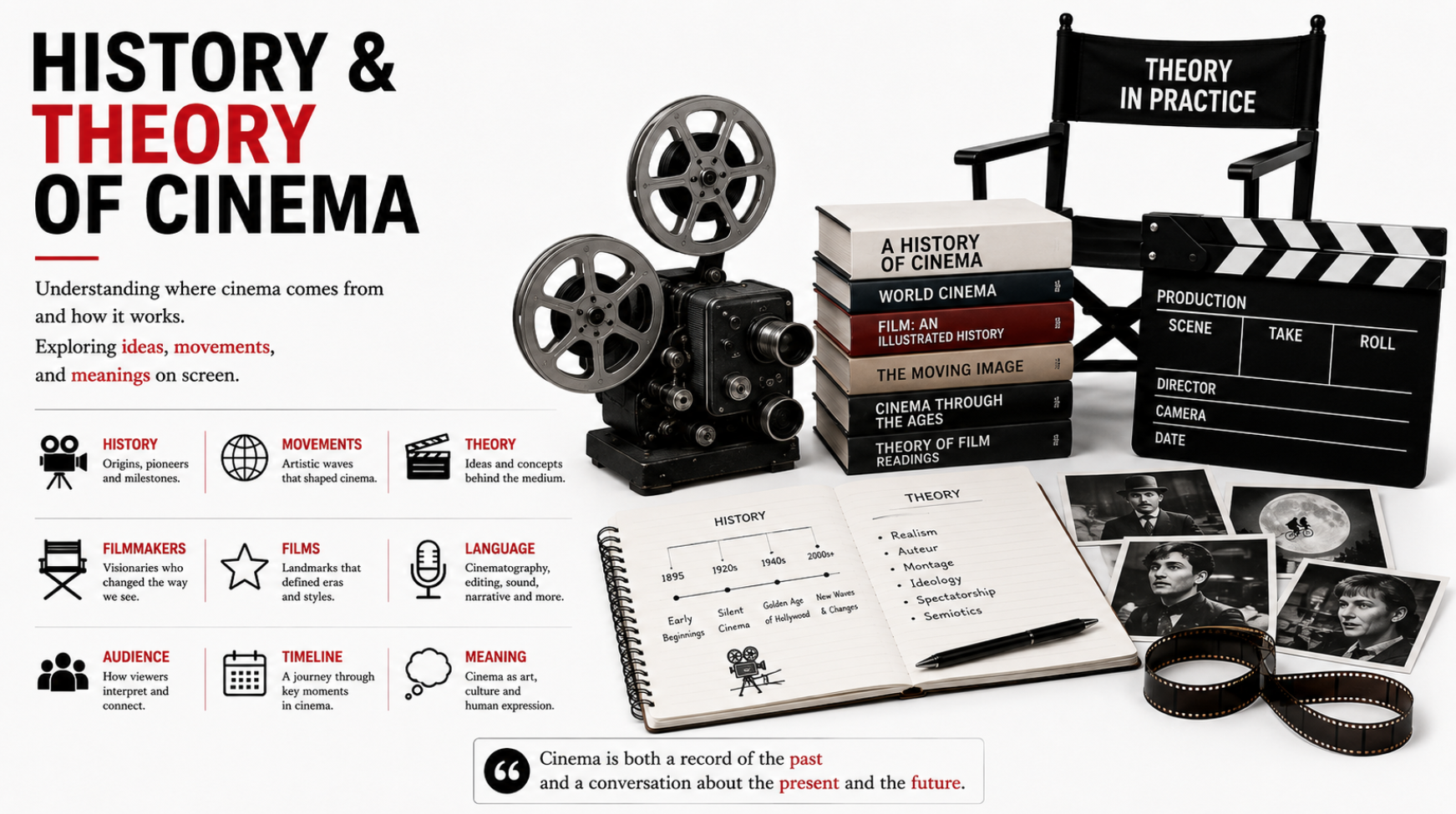
The Birth of Cinema: A History and Theory of the Moving Image
I. The Long Hunger
Sometime around thirty thousand years ago, deep inside a cave in what is now southern France, a human being pressed pigment to limestone and drew a horse. Then, beside it, another. Eight legs in sequence, four heads in motion , not a horse at rest, but a horse in mid-gallop, broken into the discrete instants that compose movement. A filmmaker looking at it today would call it a storyboard. A philosopher might ask the more uncomfortable question: why, before agriculture, before writing, before the wheel, did our species feel the need to make a stationary image run?
The birth of cinema is conventionally dated to a December evening in 1895, when the Lumière brothers projected a series of short films in a basement room in Paris. But that is the story of a machine. The deeper story , the human story , begins in the cave. Cinema, when it finally arrived, was not an invention. It was the keeping of an ancient appointment.
What separates cinema from every art that preceded it is its relationship to time. Painting captures space. Sculpture captures form. Music unfolds in duration but has no body. Literature lives only in the reader's mind. Cinema alone preserves both the body of the world and the duration of its movement. It is the first art to record time itself , not as a still photograph freezes a moment, but with the moment's life still intact. To watch a hundred-year-old film of a wave breaking on a beach is to watch that exact wave, that exact afternoon, still arriving.
II. What Cinema Was Born From
To understand what cinema is, you must understand what it was born from. The Lumière Cinématographe did not arrive into an empty culture. It arrived into a species that had spent its entire history training itself to look at images and find stories there.
The cave paintings at Chauvet, Lascaux, and Altamira , and the equally ancient paintings at Bhimbetka in central India , are not decoration. They are narrative attempts. A spear pierces a bison. Hunters surround a herd. These are not images of a single frozen instant; they are images of the world in motion, of a sequence of events unfolding. The painter working by torchlight , the flame flickering against the figures and making them seem to shift , was already producing a primitive cinema of attractions. Werner Herzog, who filmed inside Chauvet for Cave of Forgotten Dreams (2010), described what he saw there as the first awakening of the modern human soul. What he photographed looked, eerily, like a film about a film.
Before any of it was written, Homer's ancestors sang the Iliad around fires. Myth was humanity's first method of organizing time into meaning. A myth selects, condenses, and frames. It cuts from one episode to the next. It places gods in close-up and armies in long shot. Long before the cut was invented in editing rooms, it existed in the storyteller's voice.
Theatre formalized this art of presentation. In Greece, in the sixth century BCE, tragedy and comedy were performed under open sky. In India, somewhere between the second century BCE and second century CE, the sage Bharata composed the Natyashastra , a treatise of extraordinary scope covering performance, dramaturgy, music, gesture, and the psychology of the spectator. Its central concept, rasa , the aesthetic emotion produced in an audience , is one of the earliest systematic theories of what an artwork does to the people who experience it. Centuries before Aristotle's Poeticswould shape Western dramatic thought, the Natyashastra had already mapped much of the emotional architecture that cinema would inherit.
Of all the pre-cinematic arts, none anticipates the experience of a movie theatre more precisely than shadow play. In Indonesia, the wayang kulit , intricately perforated leather puppets manipulated behind a screen lit by an oil lamp , has dramatized the Ramayana and Mahabharata for over a thousand years. An audience sits in darkness and watches figures move on a luminous rectangle. Plato, in the Allegory of the Cave, used essentially this same image to describe the human condition: shadows projected on a wall, mistaken for reality. The philosophical unease about cinema that would arrive in the twentieth century , the suspicion that the moving image is a seductive illusion, a beautiful lie , was anticipated by a Greek philosopher staring into firelight two and a half millennia before the Lumières were born.
Then, in 1826, on a windowsill in rural France, Joseph Nicéphore Niépce exposed a pewter plate coated in bitumen for eight hours and produced the first photograph: a hazy rooftop view. Louis Daguerre refined the process by 1839. The image had escaped the hand.
André Bazin, the great French theorist of cinema, would later argue that this is the deepest fact about photographic media. They satisfy what he called a mummy complex , the ancient human desire to preserve the living against time. The pharaohs embalmed their bodies. The Greeks carved their dead in marble. The nineteenth century, having industrialized everything else, finally industrialized this longing too.
III. How Light Was Tamed
The principle behind every camera ever built , that light passing through a small aperture into a dark space will project an image of the outside world onto the opposite wall , was observed as early as the fifth century BCE. But the scientific understanding of optics belongs to the Iraqi-born polymath Ibn al-Haytham, who composed his Book of Optics in Cairo around 1011 CE. Ibn al-Haytham demonstrated that vision occurs when light enters the eye rather than emanating from it. His work, translated into Latin in the thirteenth century, became the basis of European optics, influencing Roger Bacon, Johannes Kepler, and ultimately the artists of the Renaissance. Leonardo da Vinci sketched the camera obscura in his notebooks around 1490. By the seventeenth century, Dutch painters , Vermeer almost certainly among them , were using the device as a drafting aid, and the results are visible in the uncanny optical precision of their interiors.
But photography, when it arrived, was static. The world could be recorded , but only one frozen slice at a time. The next problem was movement.
In 1872, Leland Stanford reportedly wagered a colleague that a galloping horse, at the height of its stride, lifts all four hooves off the ground simultaneously. He commissioned the photographer Eadweard Muybridge to find a way to settle it. After years of experimentation, Muybridge arranged twelve cameras along a track at Palo Alto, each triggered by a tripwire. In June 1878, his sequence , The Horse in Motion , proved Stanford right, and proved something far more important: that motion could be analyzed by the camera into a series of discrete, photographable instants. In France, the physiologist Étienne-Jules Marey was pursuing the same problem from a different direction. His chronophotographic plates captured birds in flight, athletes in motion, fencers mid-thrust. He produced the first visual analyses of motion that the unaided human eye could never see.
It is one of the strangest facts of cultural history that cinema , the great mass art of the twentieth century , was born in nineteenth-century physiology laboratories. The horse and the bird, broken into frames, were waiting to be put back together.
IV. The Night That Changed Everything
By the late 1880s, the necessary pieces were in place: the camera, the photographic emulsion, the understanding of motion as sequence. What remained was a mechanism to capture sequential images on a flexible strip and play them back fast enough to deceive the eye into seeing motion again.
Thomas Edison, working with his collaborator William Kennedy Laurie Dickson, produced the Kinetograph and the Kinetoscope between 1888 and 1893. His films were shot in a tar-papered shack in West Orange, New Jersey , the world's first film studio , and viewed through a peephole, one customer at a time. For Edison, cinema was a coin-operated novelty. He did not, at first, imagine the screen.
That imagination belonged to two brothers in Lyon. Auguste and Louis Lumière had built a portable apparatus combining camera, printer, and projector in a single hand-cranked device. They called it the Cinématographe.
On the evening of 28 December 1895, in the basement of the Salon Indien du Grand Café on the Boulevard des Capucines in Paris, the Lumières held the first commercial public screening. Thirty-three viewers paid one franc each. They saw ten short films, each running about fifty seconds. La Sortie de l'Usine Lumière à Lyon showed workers leaving a factory at the end of their shift. L'Arrivée d'un Train en Gare de La Ciotat showed a steam locomotive pulling into a country station. Audiences, legend has it, screamed and ducked as the train approached. Historians now consider this exaggerated. What is certain is that something began that evening that would not stop.
Within months, Lumière cameramen were screening and shooting footage in London, New York, Bombay, Shanghai, Cairo, Buenos Aires. On 7 July 1896 , barely six months after the Paris premiere , a Lumière agent projected films at Watson's Hotel in Bombay. Cinema arrived in India almost as soon as it arrived anywhere else, a fact that would give birth to the largest film industry on earth. Cinema was, from the very start, a globalizing technology.
Georges Méliès had a different idea of what it could be. Already a stage magician at the Théâtre Robert-Houdin in Paris when he attended a Lumière screening, he recognized immediately that the apparatus could be turned to the production of illusion. His camera once jammed while filming a street scene. When he viewed the footage later, a horse-drawn omnibus had transformed, mid-shot, into a hearse. The substitution splice , the most basic special effect in cinema , was discovered by accident. Over the next fifteen years, Méliès produced more than five hundred films and invented multiple exposure, dissolves, fades, hand-painted color, and miniature sets. His 1902 masterpiece Le Voyage dans la Lune became the first internationally famous film.
If the Lumières gave cinema documentary, Méliès gave it imagination. The tension between recording and conjuring was present at the very beginning. Every film made since has lived somewhere on the line between them.
V. The Language That Nobody Planned
For about thirty years , from 1895 until the end of the 1920s , cinema was silent. This is one of the most generative facts in the history of art. Deprived of the human voice, filmmakers were forced to invent a language out of pure images. By the time sound arrived in 1927, that language had been built. Almost everything we now recognize as the grammar of cinema , the cut, the close-up, the cross-cut, the dissolve, the point-of-view shot, the eyeline match , was discovered between roughly 1900 and 1925.
Edwin S. Porter's The Great Train Robbery (1903) demonstrated that film could tell a coherent story across multiple locations and multiple shots , that an audience could follow a narrative assembled from separate fragments. A decade later, D. W. Griffith , a figure whose immense formal contribution is inseparable from his deep racism , systematized this discovery in films like The Birth of a Nation (1915) and Intolerance (1916). Griffith did not invent the close-up or the cross-cut, but he wove them into a dramatic system of unprecedented emotional power. The intercutting between a woman in peril and the riders coming to save her; the cut from a wide shot of a battlefield to a close-up of a single weeping face , these were his vocabulary, and they became the world's.
The close-up, in particular, was not merely a technical device. It was a philosophical event. The Hungarian theorist Béla Balázs described it as the discovery of the face as landscape , suddenly enlarged to the size of a wall, revealing every flicker of inner life. The face of Greta Garbo. The face of Lillian Gish. The unforgettable face of Maria Falconetti in Carl Theodor Dreyer's The Passion of Joan of Arc (1928). These were images that taught audiences a new kind of looking, an intimacy with strangers that no other art form had ever made possible.
The most radical theorization of what cinema was doing came from revolutionary Russia. At the Moscow film school, the theorist Lev Kuleshov took a single, expressionless shot of the actor Ivan Mosjoukine and intercut it three times , with a bowl of soup, a child in a coffin, and a woman on a divan. Audiences praised the actor's nuanced performance: hungry, grieving, lustful. The actor had done nothing. The meaning lay entirely in the juxtaposition. The Kuleshov effect demonstrated that cinema produces meaning not in the shot but between shots. The cut is the engine.
Sergei Eisenstein took this insight and pushed it to its furthest implications. In Strike, Battleship Potemkin, and October, he developed dialectical montage , a theory of editing modelled on Hegel's dialectic, in which two contrasting shots collide to produce a third, conceptual meaning in the viewer's mind. The Odessa Steps sequence of Battleship Potemkin, in which Tsarist soldiers march in mechanical lockstep down a long staircase massacring civilians, remains, a century later, one of the most analyzed sequences in cinema.
In Germany, a different tradition emerged. The Cabinet of Dr. Caligari (1920) used painted sets, distorted perspectives, and crooked shadows to externalize psychological disturbance. F. W. Murnau's Nosferatu (1922) and Fritz Lang's Metropolis (1927) and M (1931) developed this expressionist visual language into something close to modernist painting in motion. When the rise of Nazism drove these filmmakers into exile, they took their shadows with them, and gave birth, in America, to film noir.
By the 1920s, silent cinema had become the dominant cultural form on earth. Picture palaces seating thousands rose in every major city. Sitting in a darkened auditorium, watching shadows on a wall, had become one of the defining rituals of modern life.
VI. The Questions That Cinema Forced Us to Ask
The early decades of cinema provoked, almost immediately, a set of theoretical questions that have never been fully resolved. What kind of thing is a film? Does it record the world or transform it? Is it an art, a language, a dream, or a machine for producing ideology?
The first major theoretical position came from those who insisted that cinema's artistic identity lay precisely in its difference from raw reality. The German psychologist Hugo Münsterberg, in his 1916 study The Photoplay, argued that film is not a recording of the world but a representation of the human mind , its cuts mimic the leaps of attention, its close-ups mimic memory and focus, its flashbacks mimic the mind's relation to time. Rudolf Arnheim went further: cinema's so-called limitations , the flatness of the image, the absence of sound, the rectangular frame , are precisely what make it an art. A medium that simply copied reality could never be art. Cinema is art because it abstracts.
Against this position rose, after the Second World War, the great counter-tradition of cinematic realism. André Bazin, founder of Cahiers du Cinéma and the most influential film theorist of the twentieth century, argued that the unique value of photographic media lies precisely in their unbroken connection to the real. The camera does not interpret; it records. A photograph of a dead person is, in some sense Bazin took seriously, that person , a trace of light that once touched their skin and now touches our eye. From this ontology Bazin drew aesthetic preferences: for the long take over the cut, for deep focus over montage, for the cinema of Renoir and Italian neorealism over the cinema of Eisenstein. Siegfried Kracauer extended the same argument. Cinema's vocation, he wrote, was to redeem the visible world for human consciousness , to restore our attention to the texture of things.
The dispute between formalism and realism is the foundational debate of film theory. Every later debate descends from it.
A third question concerned the viewer. What happens in the dark of the theatre, between the projector and the eye? French theorists of the 1970s , drawing on psychoanalysis and Marxism , argued that the cinematic apparatus itself produces a particular kind of subject. Cinema, in their view, is not a neutral medium through which content passes. It is a machine that constructs the spectator. Laura Mulvey's Visual Pleasure and Narrative Cinema (1975) extended this analysis to gender, arguing that mainstream cinema systematically encodes a male gaze , that the camera itself, in the classical Hollywood system, was positioned as a male eye looking at a female body.
Threading through all of these debates is the question Plato asked of the shadows in his cave. Cinema, at the level of physiology, is an illusion , twenty-four still photographs per second perceived as continuous motion because of mechanisms our brains use to construct movement from static stimuli. The question is whether this illusion is a deception, or whether , as Bazin believed, and as the long tradition from Bharata's rasa to phenomenological aesthetics has maintained , illusions of this kind are themselves a path to a deeper kind of truth.
VII. Cinema as Civilization
Cinema did not merely arrive into the modern world. It became one of the central instruments by which the modern world represented itself, organized itself, and dreamed of itself.
Note the dates. The Cinématographe was first screened in 1895. The X-ray was discovered the same year. The first commercial automobile was produced in 1894. Marconi transmitted a wireless signal across the Atlantic in 1901. The Wright brothers flew at Kitty Hawk in 1903. Cinema is part of a constellation of late-nineteenth-century technologies that together remade the human relationship to space, time, and motion. It is no accident that the very first Lumière film showed workers leaving a factory. Cinema was an art born inside the factory system, mechanically reproducible, mass-distributed, and from the start deeply implicated in the rhythms of industrial labor and leisure.
Almost immediately, states recognized cinema's power. Lenin declared it "the most important of all the arts," and the Soviet state poured resources into a film industry designed to produce revolutionary consciousness. In Germany, Leni Riefenstahl's Triumph of the Will (1935) converted mass spectacle into mythology. In Hollywood, cinema became the great factory of American self-representation, exporting the imagery of cowboys, gangsters, and lovers to every corner of the planet. In India, Dadasaheb Phalke's Raja Harishchandra (1913) , drawn from the Mahabharata , laid the foundations of what would become the world's largest film industry, one whose mythological and nationalist imagery has shaped the consciousness of generations.
Genres became the new mythology. The Western retold the American foundational myth. The gangster film dramatized the failures of immigrant capitalism. The musical celebrated and disguised the labor of performance. The melodrama traced the wound of family life. Movie stars became modern gods. Roland Barthes, in his 1957 essay on Garbo, described her face as a Platonic idea made visible , an essence of the human, projected on a wall. Cinema took up the work that mythology had performed in earlier societies: organizing collective desire, narrating origin, dramatizing fate.
But cinema's mythological power had a darker face. Every frame encodes a way of seeing, a politics of perception. The position of the camera, the choice of who is centered and who is marginal, the rhythms of editing that draw the eye one way and not another , these are not neutral choices. The history of cinema is also the history of which stories were told and which were silenced, which bodies were celebrated and which were rendered invisible. To study film seriously is to learn to read the politics inside the picture.
VIII. Everything That Came After
Everything that has happened since 1895 , the rise of Hollywood, the explosion of world cinemas, the arrival of television, the digital revolution, the streaming age, and the still-unfolding possibilities of artificial intelligence , is, in some sense, a continuation of what was begun by the Lumières and Méliès. The evolution of cinema is a single long argument with itself, conducted in moving images.
The classical Hollywood system, consolidated by the 1930s, took the formal lessons of silent cinema and disciplined them into the elegant grammar of continuity editing. Its films , from Casablanca to Singin' in the Rain to Vertigo , set a standard of narrative craft against which the rest of the world's cinema would define itself, sometimes in homage, often in rebellion.
That rebellion produced the great national cinemas of the twentieth century. Italian neorealism took cameras out of studios and into the streets of war-ravaged cities, finding non-actors and ordinary stories. The French New Wave , Godard, Truffaut, Rohmer , redefined what a movie could feel like. Japanese cinema produced, in Ozu, Mizoguchi, and Kurosawa, perhaps the most refined formal masters of the medium. In India, the parallel cinema of Satyajit Ray, Ritwik Ghatak, and Mrinal Sen developed a humanist tradition that ran alongside the commercial mythologies of Bombay. Each national cinema unfolded its own tradition, in dialogue with the West and against it.
Television dispersed the collective audience of the picture palace into the domestic intimacy of the living room. Video took film into the home. Digital technology replaced celluloid altogether. Today, streaming platforms have decoupled cinema from the theatre almost entirely. YouTube and TikTok have returned us to something like the cinema of attractions , short, exhibitionist, often non-narrative clips commanding vast audiences. Generative AI tools are producing images with no indexical relationship to any reality that ever existed, posing for Bazin's photographic ontology a challenge that film theory has only begun to absorb.
Yet the human longing that pressed pigment to limestone thirty thousand years ago has not disappeared. Whatever cinema becomes in this new century, it remains an answer to the same question: how do we hold on to what we have seen?
IX. The Republic of the Moving Image
The birth of cinema is, in the end, an episode in a much older story , the story of a species learning to give its experience a second life. The cave painter, the bard, the shadow-puppeteer, the photographer, the Lumière brothers, the YouTuber, the AI prompt engineer: these are stations along a single, long line. Each generation has done what its tools permitted with the same basic human material , light, attention, memory, the desire to make absence present again.
Cinema, in its first century and a quarter, has transformed humanity's relationship with reality, memory, myth, and imagination in ways we still struggle to measure. It has taught us to see the faces of strangers from continents we will never visit. It has preserved gestures, voices, and moments that would otherwise have vanished. It has been the dreamlife of nations and the conscience of generations. It has been, more than any other art form, the great mirror in which the twentieth century saw itself , and the lens through which the twenty-first continues to look.
To study cinema seriously is to refuse the easy assumption that the moving image is merely entertainment. It is to take seriously, as Bharata took seriously, the question of what an artwork does to the people who consume it. It is to take seriously, as Bazin took seriously, the strange ontology of photography. It is to take seriously, as Eisenstein took seriously, that meaning is constructed and that the cut is an argument. It is to take seriously, as Mulvey took seriously, that the eye is political.
Cinema began in a cave, with a single horse drawn in mid-gallop. It has not stopped running since.
💬 Discussion
0 comments