Where to Begin With Japanese Cinema — the Guided Entry Into a World So Vast, So Precise, and So Unlike Anything Else in Cinema History That It Will Permanently Change What You Expect From Film
Japanese cinema is not a national cinema in the conventional sense. It is a civilisation's relationship with time, with death, with the family, with shame, with beauty, and with the specific quality of human impermanence expressed through the most complete body of serious filmmaking any country has produced. This is how to enter it.
Before the films, a context that will make everything richer.
Japanese cinema emerged in the 1910s and developed, through the silent era, a visual language that was both internationally influenced and distinctly Japanese — shaped by the specific spatial logic of Japanese domestic architecture, by the theatrical traditions of Noh and Kabuki, by a cultural relationship with time and duration that is different from anything in Western cinema's heritage.
The sound era produced the first films that the rest of the world recognised as masterpieces. But the masterpieces were expressions of a tradition that had been developing for three decades — a tradition with its own conventions, its own relationship with genre, its own understanding of what cinema could do with the specific textures of Japanese experience.
What Japanese cinema does better than any other national cinema is this: it makes time visible. The specific weight of a moment. The specific quality of a season. The specific texture of a life at a specific point in its duration. These are not backgrounds or atmospheres. They are subjects. Japanese cinema, at its greatest, is cinema about time — about what it means to exist in it, to lose people within it, to recognise that the present moment is already passing.
Begin with this understanding. It will make every film on this list more fully itself.
The five films. In this order.
Film 1: Tokyo Story (1953) · Yasujirō Ozu Available: MUBI India, Criterion Channel
Begin here. Not because it is the most accessible Japanese film — it may not be. Not because it is the most dramatic — it is almost entirely without conventional drama. Begin here because it is the film that most completely and most immediately demonstrates what Japanese cinema at its greatest is doing — and because the understanding it produces will inform every subsequent film on this list.
An elderly couple travel from their small coastal town to visit their adult children in Tokyo. The adult children are busy. They have their own lives. They are not cruel — they are simply absorbed in the ordinary demands of their ordinary lives, and their parents' visit is an interruption of those demands. The parents return home. One of them dies.
Nothing in this description captures what the film is. What the film is: the most precise and most devastating account of what time does to families that cinema has produced. The distance that grows between people who once shared everything. The specific sadness of parents who understand that their children's lives are complete without them. The specific sadness of children who will only understand what they lost after it is gone.
Ozu's camera never moves. It sits at the height of someone seated on a tatami mat — the height of a person at rest, at home, at the level of ordinary domestic life rather than looking down on it. The compositions are formally rigorous and apparently simple. The editing is so precise that its precision is invisible. Nothing is emphasised. Everything is present.
Watch it once and you will understand what Japanese cinema is reaching for. Watch it again and you will understand why it reaches so precisely.
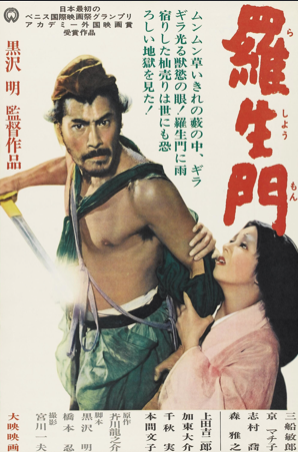
Film 2: Rashomon (1950) · Akira Kurosawa Available: MUBI India
The second film introduces you to the other pole of Japanese cinema — not Ozu's domestic intimacy but Kurosawa's philosophical and formally adventurous cinema, which engages with Japanese history and the classical literary tradition while using those materials to ask universal questions about human nature.
Rashomon tells the story of a murder — or a death — from four different perspectives, each contradicting the others. The bandit's account, the wife's account, the dead samurai's account (through a medium), and the account of a woodcutter who witnessed the event. None of the accounts is reliable. None can be reconciled with the others. The film asks, without answering: is there such a thing as objective truth, or is all human testimony a construction shaped by self-interest, self-deception, and the need to preserve a bearable image of ourselves?
Kurosawa's formal virtuosity — the forest photography, the rain, the specific quality of light in the frames — is not decoration. It is the film's visual argument: that beauty and clarity coexist with moral confusion, that the world is specifically rendered and morally opaque at the same time.
After Rashomon you are ready for the full range of Kurosawa — the jidaigeki (period films), the contemporary dramas, the Shakespeare adaptations. But begin with Rashomon because it establishes his fundamental question and his fundamental formal intelligence in a single film.
Film 3: Sansho the Bailiff (1954) · Kenji Mizoguchi Available: Criterion Channel
The third film introduces the third of the major classical Japanese directors — Mizoguchi, whose work is less widely known in India than Ozu's or Kurosawa's and whose specific achievement is as complete as either.
Mizoguchi's primary subject is the suffering of women in Japanese society — the specific ways in which women's lives have been constrained, exploited, and destroyed by social structures built entirely around male authority and male interest. He approaches this subject not through polemic but through the specific formal technique of the long take — extended shots that refuse to cut away from suffering, that make the viewer remain present with what is being shown without the relief of editorial distance.
Sansho the Bailiff is his most complete film. A government official sends his wife and children away for their safety during a period of political turmoil. The wife and children are separated, enslaved, and spend years trying to find each other. The film is based on a medieval Japanese legend but its concerns are entirely contemporary — about institutional violence, about the systematic exploitation of the powerless, about the specific cost of maintaining human dignity under conditions designed to destroy it.
The final scene is the most devastating in Japanese cinema and one of the most devastating in world cinema. It earns its devastation through the two hours that precede it — through Mizoguchi's refusal, across the entire film, to offer comfort or consolation that the situation does not justify.
Film 4: Harakiri (1962) · Masaki Kobayashi Available: Criterion Channel
The fourth film takes you into less familiar territory — the Japanese cinema of social critique that operates through the samurai genre to examine the gap between institutional codes of honour and the human reality that those codes destroy.
A ronin arrives at a clan's estate and requests permission to commit ritual suicide in their courtyard — a practice that had become common as a means of extracting payment from wealthy clans. The clan elder tells him the story of the last ronin who made the same request, thinking to deter him. What follows is one of the most precisely structured narrative reversals in cinema — a film that appears to be moving in one direction and is in fact moving in the opposite direction, using the conventions of the samurai genre to make an argument about institutional hypocrisy that the genre does not normally permit.
Kobayashi's formal control is extraordinary — the black-and-white cinematography uses shadow and geometric composition to create a visual world of absolute clarity and moral darkness. The film is visually beautiful and morally brutal. It is also the film that will expand your understanding of what the samurai genre — which you will encounter throughout Japanese cinema — is capable of when a serious filmmaker uses its conventions as critical instruments rather than simply as entertainments.
Film 5: Shoplifters (2018) · Hirokazu Kore-eda Available: MUBI India, Netflix
The fifth film brings you to the contemporary Japanese cinema that is in direct conversation with the tradition you have spent the previous four films entering.
Kore-eda is the most complete contemporary Japanese filmmaker and the one whose work most directly continues the tradition of Ozu — the domestic scale, the specific texture of ordinary life, the investigation of what families are and what binds people together when the conventional definitions of family do not apply.
Shoplifters follows a group of people living together in poverty in contemporary Tokyo — petty criminals who have formed a family not through blood but through proximity, need, and specific acts of care. The film examines what family actually is — what constitutes the bond, whether chosen family is the same as biological family, what the state's insistence on the nuclear family as the only legitimate form of human attachment costs the people who cannot or do not fit within it.
Kore-eda won the Palme d'Or at Cannes for this film. The award is correct. Shoplifters is the film that connects every previous film on this list to the world you currently live in — the final proof that the tradition of Japanese cinema, from Ozu's tatami-height camera to Mizoguchi's long takes of female suffering, is a living tradition that is still producing the most humane and the most formally precise films being made anywhere.
Where to go next
After these five films, in any order: Seven Samurai and Ikiru by Kurosawa, Late Spring and Late Autumn by Ozu, Ugetsu and The Life of Oharu by Mizoguchi, After Life and Still Walking by Kore-eda. Then the directors who are less known internationally but equally essential: Shohei Imamura, Nagisa Oshima, Seijun Suzuki, Yoshida Yoshishige. Then the contemporary generation: Ryusuke Hamaguchi, whose Drive My Car won the Academy Award for Best International Film in 2022 and is the most formally accomplished Japanese film of the current decade.
Japanese cinema is inexhaustible. Every time you think you have seen enough you discover another director, another tradition, another approach to the fundamental questions that all Japanese cinema keeps returning to. That inexhaustibility is not a feature of the size of the catalogue. It is a feature of the depth of the tradition. Enter it through these five films. You will not leave.
💬 Discussion
0 comments