★★★½ out of 4 · Republic of Cinema · First Look
Directed by Christopher Nolan · Written by Christopher Nolan, based on Homer's Odyssey · Cinematography Hoyte van Hoytema · Edited by Jennifer Lame · Music Ludwig Göransson · With Matt Damon, Anne Hathaway, Tom Holland, Robert Pattinson, Zendaya, Lupita Nyong'o, Charlize Theron, Jon Bernthal, Benny Safdie, Samantha Morton, John Leguizamo, Himesh Patel, Mia Goth, Elliot Page · Universal Pictures / Syncopy · R, 173 minutes · Released July 17, 2026
A man climbs onto a table in a banquet hall and begins to tell a story. The room quiets. He speaks of a wooden horse and the burning of a city, of a soldier clever enough to win a war and foolish enough to think the winning was the hard part. The man on the table is not Odysseus, and the story he tells is not quite the story we are watching. He is one small voice inside a much larger telling, and Christopher Nolan lets us understand, in those first minutes, that "The Odyssey" is a film about the stories we build to survive the things that happen to us. Homer's poem has always been a story told at second hand, sung by a poet about a man who was himself a great liar. Nolan begins where the poem's oldest instinct lives: with a performer, a fire, and an audience that wants to believe.
Odysseus is played by Matt Damon, and it is a shrewd bit of casting. Damon has always carried an ordinary decency on his face, the look of a man you would trust to drive you to the airport, and Nolan uses that plainness against the grandeur of the frame. This Odysseus is not a demigod striding through myth. He is a soldier who has seen too much and lied his way home. When he weeps , and he weeps often, at feasts, hearing other men sing about the war he fought , the tears are not heroic. They are the tears of a man who cannot stop the war from playing behind his eyes.
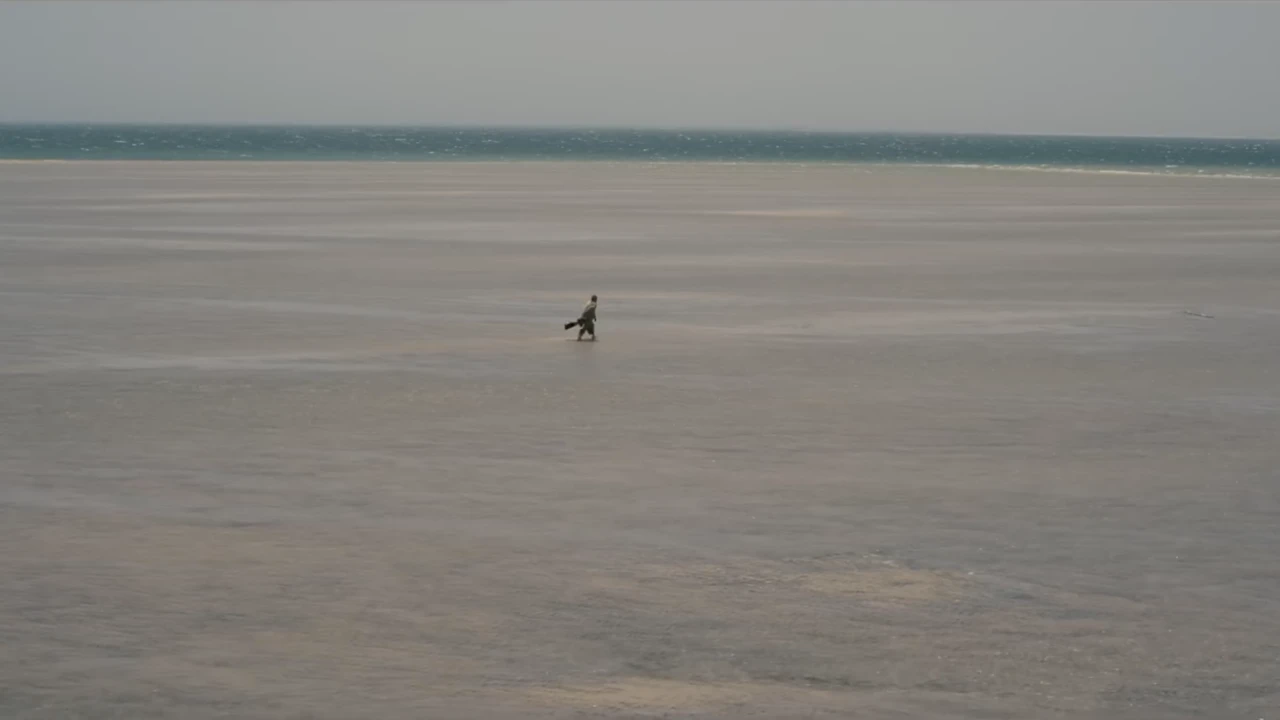
The shape of the thing is familiar to anyone who has carried the book. Troy falls. The long way home begins, ten years of it, across a sea that will not let him land. There is the island of the sorceress, where his men are fed and stroked and coaxed until they are no longer men but animals rooting in the mud , a sequence Nolan stages as something close to horror, tender and grotesque at once, a warning about appetite dressed as hospitality. There is the nymph who keeps him as a lover for years on a beach that should be paradise and feels like a prison. And there is Ithaca, always Ithaca, where Penelope waits.
Anne Hathaway plays her, and the film is smart enough to give her a war of her own. Her palace has been colonized by suitors who eat her stores and drink her wine and insist, with the confidence of men who have decided a thing, that her husband is dead. She holds them off with a trick , weaving a shroud by day, unraveling it by night , which is to say she survives the way her husband survives, by telling a story and making it last. Robert Pattinson plays Antinous, the loudest and cruelest of the suitors, and he brings a bored, entitled menace to the part; he is the kind of man who has never once been told no. Tom Holland is Telemachus, the son who has never met his father and must decide whether to believe his mother's faith or the travelers who bring no news. Holland, who has spent a decade playing boys, plays here a boy at the exact moment he stops being one.
Above all this moves Athena, and Nolan makes an interesting choice by casting Zendaya in the role and then refusing to settle whether she is a goddess at all. This is the film's boldest gamble. Nolan has said he wanted a realistic reading of the myth, and he keeps the gods at the edge of the frame, ambiguous. When Odysseus speaks with Athena, we are never certain whether a goddess has appeared to him or whether a broken man is talking to the voice in his own head that keeps him alive. When storms wreck his ships, we cannot say whether Poseidon is angry or the sea is simply the sea. The film leaves the door open, and lets us decide how much of a man's fate he authors and how much is done to him , which is, when you think about it, the oldest question the poem asks.
The dialogue is modern, blunt, American, and it lands strangely at first, the way a familiar song does in an unfamiliar key. I resisted it for twenty minutes and then stopped noticing, because Nolan is not after the marble solemnity of the old sword-and-sandal pictures. Hollywood had not attempted a straight telling of this poem in something like seventy years, and one suspects it was the sheer weight of the thing that scared everyone off. Nolan is not scared of weight. He shot the film across the world on IMAX cameras, at a cost that would fund a small nation's cinema for a decade, and Hoyte van Hoytema's images have the scale of weather. Ludwig Göransson scores it with instruments built to sound like the ancient world, so that the music seems to rise up out of the ground the story is standing on.
Nolan is fifty-five now, an Oscar in hand for "Oppenheimer," and he has spent his career circling a single obsession: time, and what it does to a person made to wait inside it. His men are always trying to get back to something , a wife, a child, a moment before the mistake. Cooper falling through the years in "Interstellar," Oppenheimer haunted forward and backward at once. "The Odyssey" may be the purest version of that obsession he has made, because the poem is nothing but a man trying to get home while time steals the home out from under him. Some have called the film cold, aloof, more monument than embrace, and there is something to the charge; Nolan admires his hero more than he warms to him. But I think the distance is the point. Odysseus has been away so long that home has become a story he tells himself, and the ache of the film is watching him arrive and find that a story, once you finally reach it, has to be lived.
The image I keep is not the slaughter of the suitors, though it comes, terrible and earned. It is the bed. When Odysseus at last stands before Penelope and she cannot be sure it is him , twenty years is a long time, and the man before her is grayer, harder, a stranger wearing her husband's scars , she sets him a trap. She orders the servants to move their marriage bed. And he tells her, with a flash of the old anger, that the bed cannot be moved: he built it himself around a living olive tree, rooted in the earth, its post a trunk that still grows. That is the secret only the two of them know. It is the proof. And it is Homer's quiet, three-thousand-year-old answer to everything the wine-dark sea could throw at a man. The world will not stay still. The gods, if they are gods, will not be kind. But a marriage, if it is real, is a tree grown into the floor of the house , and a man can wander the whole ruined earth and still, if he is very lucky, come home to something that could not be moved.
💬 Discussion
0 comments