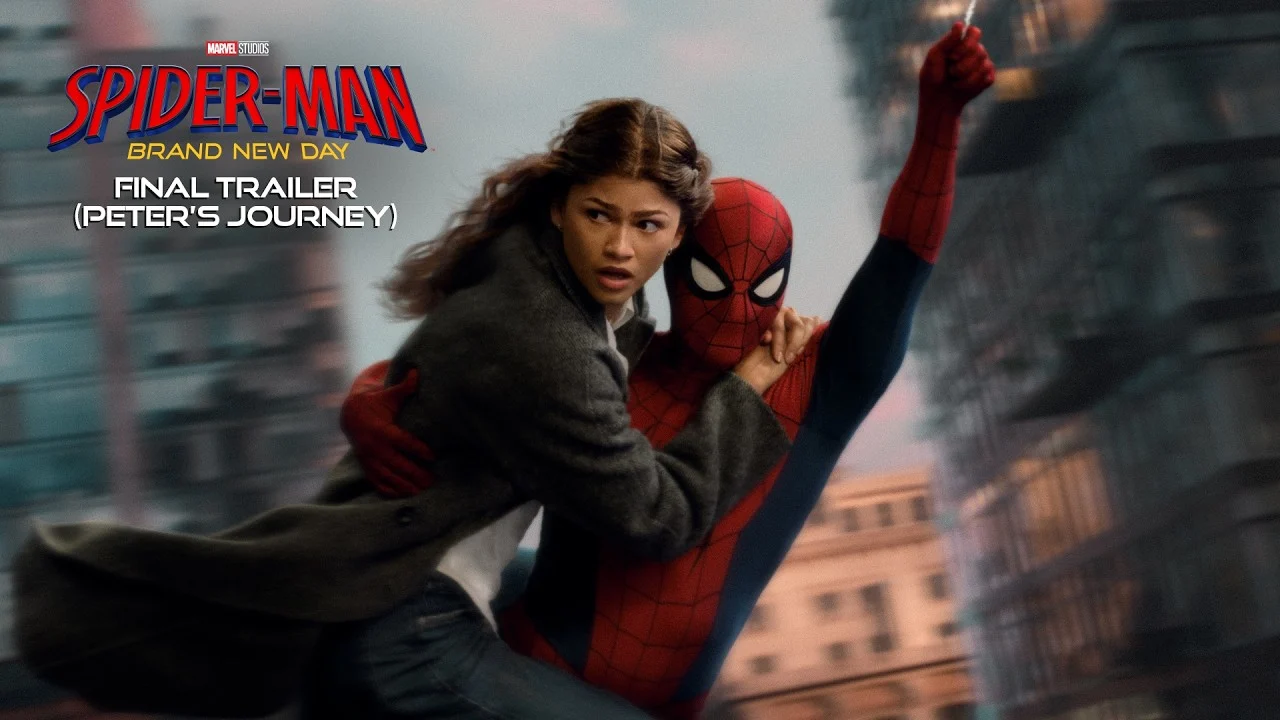
★★★½ out of 4 Republic of Cinema · First Look
Directed by Destin Daniel Cretton · Written by Chris McKenna & Erik Sommers · Cinematography Brett Pawlak · Edited by Nat Sanders and Gina Sansom · Music Michael Giacchino · With Tom Holland, Zendaya, Sadie Sink, Jon Bernthal, Jacob Batalon, Mark Ruffalo, Tramell Tillman, Michael Mando, Liza Colón-Zayas · Sony Pictures / Marvel Studios / Columbia Pictures · PG-13, 145 minutes · Released July 31, 2026
There is a moment early in Spider-Man: Brand New Day in which Peter Parker stands in front of the two people he loves most in the world and they look through him. Ned does not know him. MJ does not know him, and she has a boyfriend now, and she is polite in the way you are polite to a stranger who has stood too close for a second too long. Nothing explodes. No building falls. It is the quietest scene in a movie that will later drop a skyscraper's worth of noise on our heads, and it is the only scene the rest of the film is actually about.
This is where the last picture left him. At the end of Spider-Man: No Way Home (2021), Peter asked a sorcerer to make the world forget his name, and the world obliged, and the price was everyone. His aunt was already gone. Now his friends are gone too, not dead but worse , alive, nearby, and unavailable. Four years have passed in fiction. He lives alone in a walk-up. He has an AI in his ear (voiced by Naomi Watts) because there is no one else to talk to. He fights crime constantly, the way people work constantly when they are afraid of the evening.
Destin Daniel Cretton, who made Short Term 12 and Just Mercy before Marvel found him and handed him Shang-Chi, understands that this is a film about a person who has run out of people. He also understands that he has been given roughly two hundred and twenty-five million dollars and an obligation to entertain the planet. What is surprising is how often he manages both in the same shot.
The plot, which is busier than it needs to be, concerns the Department of Damage Control , the bureaucracy that sweeps up after superhuman catastrophes, here run by a silken, unreadable Tramell Tillman , and a young woman who can climb into the minds of strangers and wear them like coats. She is looking for something inside their vault. Peter is the one person she cannot possess, which makes him useful to the government and interesting to her. Along the way, Michael Mando's Scorpion finally pays off a joke Marvel made in a post-credits scene back in 2017, Marvin Jones III's Tombstone turns up, the ninja clan called The Hand turns up, and Mark Ruffalo's Bruce Banner turns up to explain to Peter what it is like to be losing an argument with your own biology.
Because Peter is losing that argument. His powers have gone wrong , too much spider in the blood, not enough man , and he begins to fear what he is turning into. Anyone who saw Sam Raimi's Spider-Man 2 in 2004 will recognize the shape of this: the hero who cannot stick to the wall, who cannot see without his glasses, whose body files a grievance against his vocation. Raimi used it as comedy and pathos. Cretton uses it as horror, and it works, because a boy who has already lost everyone outside himself is now losing the thing inside himself as well.
Tom Holland has played this character across four solo films , no other actor has been given so long a run at it , and he has finally been handed the material to justify the tenure. He was a wonderful boy. He is a better man. There is a stillness in him here that was not available to him in Homecoming; he lets whole scenes pass on his face without the reflex of a joke. Zendaya, given the hardest assignment in the picture , playing warmth toward someone you are contractually not permitted to remember , is very fine and very sad. Jon Bernthal's Frank Castle walks in and takes the movie under his arm. He is not a friend to Peter, exactly. He is what a friend looks like when you have no others: someone who will show up, who will not ask, who will do something unforgivable and then look at you steadily while you decide what to do about it.
And then there is Sadie Sink, whose identity Marvel guarded for a year and which I will not spend here. What matters is not the name. What matters is that she is playing the mirror. She is a girl who has lost her family to an institution and has decided that the only remaining moral option is force. She is alone in exactly the way Peter is alone, and she has drawn the opposite conclusion from it. The film's best idea is that these two are the same person with different arithmetic.
The action is heavy, tactile, and mostly earned. Cretton is a genuinely good director of physical combat , he brings a dancer's sense of the frame from Shang-Chi , and much of Brand New Day was staged practically, which you feel in your spine. A sequence built around the Hulk tearing through the Damage Control tower is the sort of thing IMAX was invented to sell. Michael Giacchino's score knows when to shut up. Brett Pawlak shoots the city at street level, low and close, the way Ditko drew it. There are shots lifted straight off comic covers and they land, not as fan service but as punctuation.
The film is not perfect and I would not want you to go in believing it is. At 145 minutes it carries at least one subplot too many, and one of them is simply abandoned. The web-swinging effects are, at moments, less convincing than the fistfights around them. And there is a structural resolution near the end , a softening , that some will find merciful and others will find a loss of nerve. Owen Gleiberman in Variety found the whole enterprise strenuously reaching for maturity; Brian Tallerico at RogerEbert.com found it transitional, a bridge to films not yet made. Both are fair readings. Neither is what happened to me in the theatre.
What happened to me is that a superhero movie remembered what its own moral proposition means. Stan Lee and Steve Ditko put a teenager on the cover of Amazing Fantasy in 1962 and gave him a sentence about power and responsibility, and the sentence has been repeated so many times since that it has worn smooth like a coin. But responsibility in this story has never really been about capability. It is about debt. Peter did not choose the spider. He inherited an obligation from an accident, the way we all inherit obligations we did not consent to , to our dead, to our teachers, to strangers, to the city we happen to live in. The Sanskrit word is ṛṇa: a debt you did not take out and cannot refuse. Every version of Peter Parker is a boy trying to pay it. This one is the first in a while to notice that paying it alone will kill you.
The title comes from a 2008 comics run in which Peter's marriage was magicked away and the world forgot him , the same bargain the movies made in 2021, arriving at the same conclusion by a different road. A brand new day is not a gift. It is the morning after everything is taken.
The audiences have shown up in numbers that are frankly hard to hold in the mind: the biggest opening day in the history of American exhibition, a domestic weekend of roughly $355 million, over $900 million worldwide before its first Monday, an A from CinemaScore and a 98 percent audience score , the highest any solo Spider-Man film has recorded. Kevin Feige has been calling it a movie about friendship. He is not wrong, though friendship is the answer and not the subject. The subject is what it costs to go without one.
The last true image in Brand New Day is not a skyline or a suit or a stinger promising the next instalment. It is a boy throwing his body in front of a bullet meant for the person who has spent the entire film trying to destroy him. He does not deliberate. He does not make a speech. He simply gets there first, which is the only definition of the character that has ever mattered, and he goes down in the street of a city that does not know his name.
Spider-Man: Brand New Day is playing in theatres, and should be seen in the largest room you can find.
💬 Discussion
0 comments