A canon built on formal innovation rather than received reputation. Every film on this list did something that had not been done before it and that changed what came after it. The measure is not greatness in the abstract. It is the specific contribution — the formal or philosophical discovery that this film made and that cinema has been working with ever since.
A canon argument is only honest if it is willing to be argued with. What follows is not a definitive list. It is a position — a claim that these twenty films represent the moments when cinema most completely discovered a new capability — and the defence of each placement is as important as the placement itself.
01. The Arrival of a Train at La Ciotat (1895) · Lumière Brothers The discovery: that a moving image could create the experience of reality. Audiences fled. They believed the train was coming toward them. The moving image had never been seen before and the human perceptual system had no way to process it as representation rather than presence. Everything in cinema begins here — with the discovery that a flat image in motion could trigger the same neural responses as physical reality.
02. The Birth of a Nation (1915) · D.W. Griffith The discovery: that editing could construct narrative across time and space. It is necessary to include it and necessary to acknowledge what it is. Griffith's film is a technical masterpiece and a moral catastrophe — the most technically innovative American film of its era and a work of explicit white supremacist propaganda that directly inspired the revival of the Ku Klux Klan. Its formal innovations — the close-up, parallel editing, the moving camera — changed cinema permanently. Its content caused real harm. Both facts must be held simultaneously.
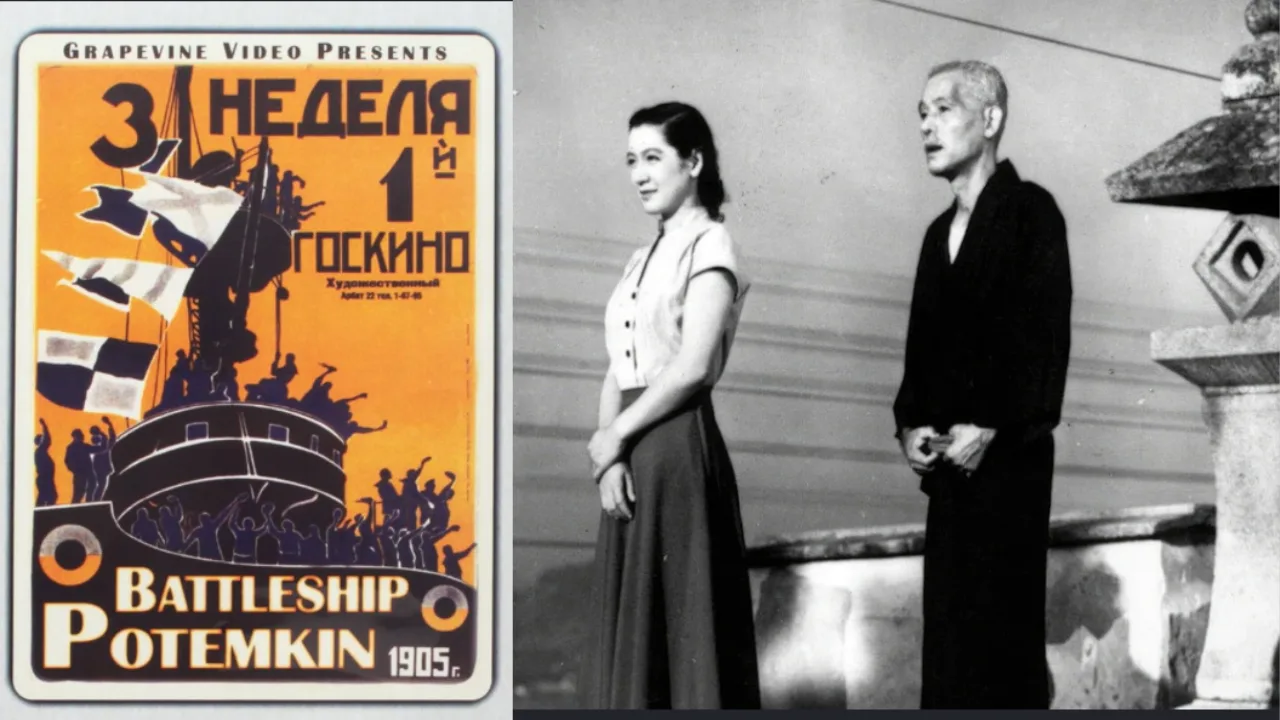
03. Battleship Potemkin (1925) · Sergei Eisenstein The discovery: that editing could create political meaning that existed in neither shot. The Odessa Steps sequence does not simply depict a massacre. It creates, through montage, a moral experience of the massacre that exceeds documentation. The famous baby carriage is not simply an image of innocence in danger. It is an argument — assembled from fragments — about the specific vulnerability of the civilian before the violence of the state. Eisenstein proved that cinema could be a philosophical instrument.
04. Sunrise: A Song of Two Humans (1927) · F.W. Murnau The discovery: that the moving camera could be an emotional instrument. Murnau moved the camera in ways it had never moved before — tracking, craning, floating through space in ways that created a specific emotional identification between viewer and character. The camera's movement through the film is not a technical demonstration. It is a feeling.
05. Tokyo Story (1953) · Yasujirō Ozu The discovery: that stillness could be as emotionally powerful as movement.Every previous technical discovery in cinema was about extending what the camera could do. Ozu discovered what the camera could do by refusing to do any of it. No movement. No dramatic lighting. No editorial emphasis. And the result was more emotionally devastating than films that used every available technique. The formal refusal is the argument.
06. Pather Panchali (1955) · Satyajit Ray The discovery: that natural light and non-professional actors could produce images more truthful than any studio production. Not simply the Italian Neorealist discovery — Ray extended it into a specific cultural and geographical reality that Neorealism could not reach. What Subrata Mitra discovered about natural light in Bengal was not available to Vittorio De Sica in Rome.
07. Vertigo (1958) · Alfred Hitchcock The discovery: that cinema could make the viewer's own psychology the subject of the film. Hitchcock spent forty years making films about looking. Vertigo is the film where the subject of looking — the specific pathology of the male gaze, the specific relationship between obsession and the construction of the ideal — becomes the film itself rather than its engine. The dolly zoom is not a trick. It is the externalisation of a psychological state that no previous cinema had found a visual equivalent for.
08. Breathless (1960) · Jean-Luc Godard The discovery: that the visible edit — the jump cut — could be a philosophical position. When Godard made the edit visible he was not making a formal mistake or a formal experiment. He was making a claim about what cinema owed its audience — the right to know they were watching a construction, the right not to be deceived by the continuity system's pretence of a transparent window onto reality.
09. L'Avventura (1960) · Michelangelo Antonioni The discovery: that narrative absence — a missing character, an unresolved question — could be the film's subject. A woman disappears on an island in the film's first act. She is never found. The film does not forget about her — her absence is its constant subject — but it refuses to find her. In refusing to provide the resolution that narrative cinema always provides Antonioni discovered that the gap between what we expect from stories and what life actually provides is itself a subject.
10. 8½ (1963) · Federico Fellini The discovery: that cinema could think about itself without becoming merely self-referential. A film about a director who cannot make a film, in which every attempt to separate the director's memories, fantasies, and present experience fails because the mind does not keep them separate. Cinema had been making films about filmmaking since the beginning. 8½ was the first film to use self-reference as a philosophical instrument rather than a formal game.
11. 2001: A Space Odyssey (1968) · Stanley Kubrick The discovery: that cinema could operate as a philosophical instrument without narrative. The last twenty minutes of 2001 have no conventional meaning. They have only experience — the experience of time passing, of consciousness transforming, of something that cannot be named occurring. Kubrick discovered that cinema could contain experiences that resist explanation and that the resistance was not a failure but the point.
12. Jeanne Dielman (1975) · Chantal Akerman The discovery: that duration could be a political instrument. By holding shots of domestic labour for longer than any cinema had held them before, Akerman made visible what cinema had always refused to make visible — the specific quality of time as experienced by a woman whose life consists of work that has no cultural value. The three-hour running time is not a test of the audience's patience. It is the argument.
13. Apocalypse Now (1979) · Francis Ford Coppola The discovery: that cinema could use its own technical apparatus — sound, image, scale — to create a physical experience of psychological dissolution. The film does not describe madness. It creates it — through the specific relationship between the helicopter sound and the ceiling fan, through the specific progression from jungle to compound, through the specific quality of light in the final sequences. The viewer does not understand Willard's experience. They share it.
14. Sans Soleil (1983) · Chris Marker The discovery: that cinema could be an essay — could think, in images and words, about time and memory and the relationship between seeing and understanding. The essay film existed before Sans Soleil. But Sans Soleil is the film that demonstrated that the essay form could achieve in cinema what the essay achieves in literature — a form of thinking that is available in no other mode, combining the precision of language with the specificity of the image.
15. Close-Up (1990) · Abbas Kiarostami The discovery: that the boundary between documentary and fiction was permeable in ways that both enriched and complicated both. Kiarostami filmed a real trial, then reconstructed the real events with the real people, and then asked the viewer to determine which parts were which. The question proved unanswerable in the most interesting way — because the reconstruction was as real as the documentation, because performance and being are not as different as cinema normally pretends.
16. In the Mood for Love (2000) · Wong Kar-wai The discovery: that cinema could express what language cannot — desire without outlet, love without declaration, the specific texture of what is not said. Wong's film does not describe its subject. It creates the experience of its subject — the specific feeling of being in the presence of someone you love and cannot reach — in a way that language cannot approximate and that no other film has quite equalled.
17. Mulholland Drive (2001) · David Lynch The discovery: that the viewer's experience of confusion and disorientation could itself be the film's subject — that cinema could generate meaning through the experience of meaning's absence.Lynch did not make a film with a hidden meaning waiting to be decoded. He made a film whose experience of incoherence is the most accurate representation of dream logic available in any art form. The meaning is the confusion.
18. Elephant (2003) · Gus Van Sant The discovery: that cinema's refusal of conventional narrative could be a moral position rather than simply a formal one. By refusing to explain, dramatise, or provide catharsis for a school shooting, Van Sant forced the viewer to examine their own desire for those things — to recognise that the demand for narrative resolution is a demand that real violence rarely satisfies, and that cinema's conventional satisfaction of that demand is a form of dishonesty.
19. 4 Months, 3 Weeks and 2 Days (2007) · Cristian Mungiu The discovery: that real time — the refusal to cut — could create moral weight more completely than any amount of editorial emphasis. The dinner table scene. A woman sitting at a table while conversation happens around her that she cannot engage with because of what she is carrying. Mungiu holds the shot without cutting. The viewer is not allowed the relief of a new angle. They must remain present. That remaining is the moral experience the film requires.
20. Parasite (2019) · Bong Joon-ho The discovery: that formal sophistication, moral complexity, and complete popular accessibility are not in opposition — that the most demanding cinema can also be the most entertaining. Not a discovery in the same sense as the others — Bong did not invent a technique. But Parasite demonstrated something that needed demonstrating: that every formal discovery on this list can be incorporated into a film that everyone wants to watch. That the tradition and the audience are not in opposition. That the serious and the popular are not enemies. That discovery was worth making.
By the Republic of Cinema Editorial Team · The Canon · World Cinema · Republic of Cinema
💬 Discussion
0 comments