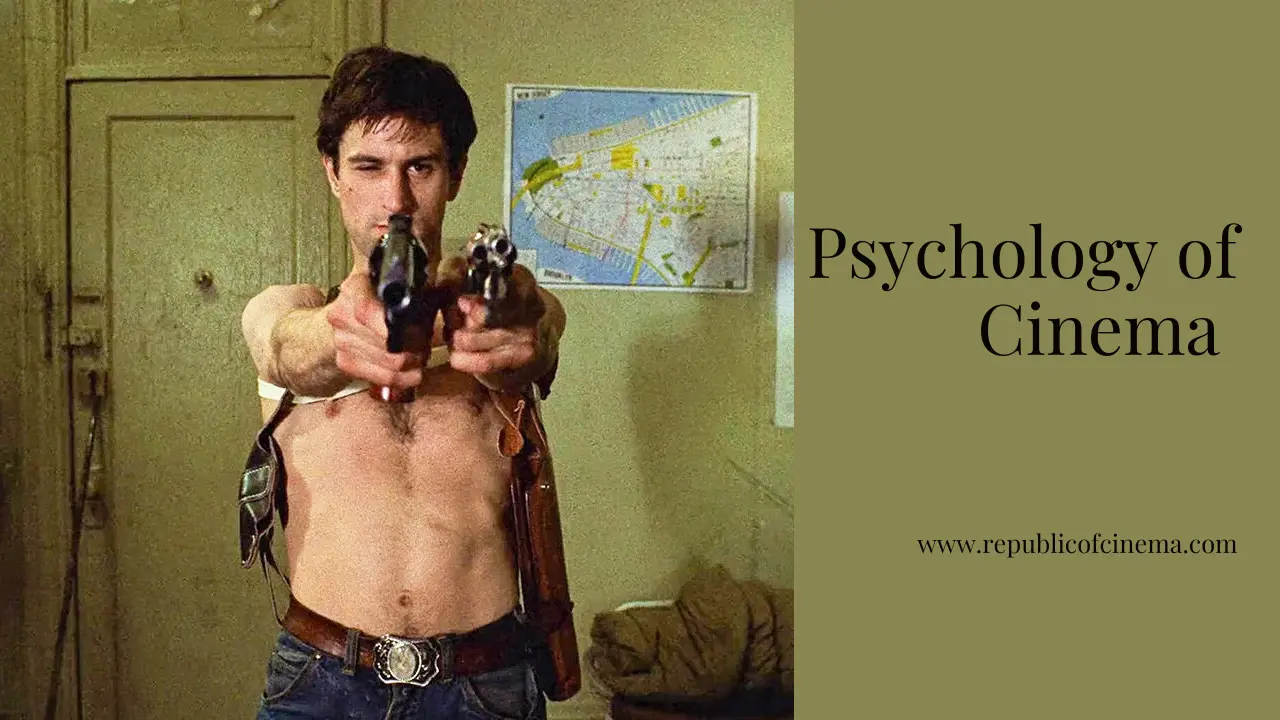
You root for Travis Bickle. You root for Alex DeLarge. You root for Amy Dunne. You know they are doing terrible things and you root for them anyway. This is not a moral failure. It is a precise psychological mechanism — and understanding it changes everything about how you experience every film you watch.
Begin with a specific moment.
You are watching Taxi Driver. Travis Bickle has been building toward violence for the entire film. You have watched him descend into isolation, into delusion, into a specific kind of righteous masculine rage that the film presents without endorsing. You know what he is about to do. You know it is wrong. You know that the political figure he is planning to assassinate is not a villain and that Travis's plan to kill him is the action of a disturbed and dangerous man.
And then the Secret Service agents appear, the assassination becomes impossible, and Travis redirects toward the pimp who controls the underage girl he has decided to rescue — and something in you, if you are watching honestly, feels relief.
Not approval. Relief. Something that functions like satisfaction that the violence is going to happen, that the pressure that has been building across the entire film is going to be released.
This is not an accident of your character. It is a deliberate construction of Scorsese and Schrader, using mechanisms of psychological identification that cinema has been deploying since Griffith. Understanding those mechanisms is not simply intellectually interesting. It is the key to understanding how cinema works on you — and what your response to it reveals about your own psychology.
How identification actually works
The term identification is used loosely in cinema discussions to mean something like "caring about a character." But the psychological mechanism is more specific and more interesting than this suggests.
Psychologists distinguish between several forms of what cinema produces. Empathy is the capacity to feel what another person feels — to access their emotional state from within. Sympathy is the capacity to feel for another person — to respond to their emotional state from outside. Identification is something different from both — a temporary dissolution of the boundary between self and character, a process by which the viewer's perspective and the character's perspective temporarily merge.
Identification in cinema is produced primarily by three mechanisms.
The first is point of view. When the camera shows us what a character sees rather than showing us the character seeing, we are placed inside that character's perceptual position. We see what they see. We do not observe them seeing — we see with them. This alignment of perspective is the foundation of identification regardless of the character's moral status.
The second is information asymmetry. When we know more than a character, we are positioned outside them — we observe them from a position of superior knowledge. When we know the same as or less than a character, we are positioned alongside them — we experience the same uncertainty, the same incomplete information, the same need to interpret what is happening. This equal footing is the condition that makes identification possible.
The third is desire. When a film shows us what a character wants and then builds obstacles between the character and what they want, it activates the most basic narrative mechanism in human psychology — the goal-obstacle-resolution structure that underlies every story ever told and that our minds are constitutionally primed to respond to. We root for characters to achieve their desires not because we endorse those desires but because the desire-obstacle-resolution structure triggers an automatic rooting response that precedes moral evaluation.
Travis Bickle wants something. His city, his isolation, his psychology have made that something terrible. But the want is real and the obstacles to it are real and the structure of the film activates our rooting response before our moral evaluation has time to override it.
The Kuleshov effect and what it proves
Lev Kuleshov, a Soviet filmmaker working in the early 1920s, conducted the most important experiment in the history of film psychology. He took a single, expressionless close-up of an actor's face and intercut it with three different images — a bowl of soup, a dead child, a beautiful woman. He showed the sequence to audiences who consistently reported that the actor's expression changed across the three versions — that they could see hunger when the soup appeared, grief when the dead child appeared, desire when the woman appeared.
The actor's face was identical in all three versions. The audiences were not lying or performing. They were experiencing what the psychologist Daniel Kahneman would later call System 1 processing — automatic, unconscious, involuntary meaning-making that happens before conscious evaluation.
The Kuleshov effect proves something with experimental rigour that every filmmaker has always known intuitively: meaning in cinema is not in the shot. It is between the shots. The viewer's mind creates meaning from the juxtaposition — and does so automatically, without conscious participation.
This has profound implications for how identification works. When a film places a character's face next to the object of their desire, the viewer automatically attributes the desire to the face. When a film places a character's face next to a threat, the viewer automatically attributes fear to the face. The attribution happens before moral evaluation. By the time you have consciously assessed whether the desire is good or the fear is justified, the identification has already occurred.
What this means for how you watch
The psychological mechanisms of cinematic identification are not flaws in your psychology. They are features — evolved capacities for social understanding that cinema has learned to activate more precisely than any previous storytelling form.
But understanding them changes your relationship with your own responses. When you feel relief that Travis Bickle can redirect his violence, you are not revealing a secret approval of vigilante justice. You are revealing that the film has successfully activated your desire-obstacle-resolution system with a character whose desires are morally compromised.
The interesting question is not whether this makes you a bad person. It does not. The interesting question is what a filmmaker's responsibility is when using these mechanisms — whether the activation of identification with a morally compromised character should be followed by a reflective moment that allows the viewer to examine their own response, or whether the film can simply exploit the mechanism and move on.
Taxi Driver is a film that asks you to examine your relief. The final sequence — the newspaper clippings, the hero's welcome, the suggestion that Travis's violence has been socially sanctioned — is designed to make you uncomfortable about the relief you felt. The discomfort is the film's moral argument.
A Clockwork Orange is a film that asks you to examine your enjoyment of Alex's violence in the first act by making you experience its opposite — the horror of violence done to Alex — in the second. The reversal is structurally designed to produce self-examination.
The films that use identification most responsibly are the films that not only produce the identification but reflect it back to you — that make visible, in some form, the mechanism they have just used. That visibility is what distinguishes a film that manipulates its audience from a film that collaborates with its audience. Learning to see the mechanism is the beginning of the collaboration.
By Republic of Cinema · Psychology of Cinema · Cinema Studies · Republic of Cinema
💬 Discussion
0 comments