There is a moment early in Peter Parker's life when he is alone in a room, practicing a sentence. He is trying to work out how to walk up to the woman he loves and explain that they used to know each other, that they were together, that the world was made to forget him in order to save her. He rehearses it. He gets it wrong. He tries again. It is the loneliest scene in any of these films, and it is played almost entirely by a man's face, which is worth noting, because for ten years now Tom Holland has been the most famous actor in the world at working with his face covered.
I keep returning to the mask. Of all the costumes in the Marvel enterprise , the armor, the shield, the cape , Spider-Man's is the only one designed by artists who understood that a hero who hides his face must find some other way to have an expression. Steve Ditko drew those white lenses in 1962 as flat teardrops, and every illustrator since has cheated them, narrowing them into a squint of concentration, widening them into panic. The lenses act. In the films they are mechanical, and they blink. It is a small and slightly absurd piece of engineering, and it exists because someone recognized the central problem of the character: a boy who cannot be seen must still be legible.
Holland solved that problem before the effects department did. He solved it with his spine.
The boy who trained for two years to get the part
He was eleven, taking hip-hop classes at a dance school in south London, when a choreographer noticed him and suggested he audition for the West End production of Billy Elliot the Musical. He did not get it. He spent the next two years learning ballet, earned a supporting role in 2008, and by the end of that year had taken over the title role, which he played until 2010 , a boy playing a boy who dances in defiance of a father who wants him not to.
I do not think you can understand Holland's Spider-Man without that fact sitting at the front of your mind. He came to film from the theatre by way of the body. His debut was The Impossible in 2012, a film about a family torn apart by water, in which a fourteen-year-old was asked to carry long stretches of screen time on the strength of a face doing very little and doing it exactly. Then How I Live Now, then In the Heart of the Sea, and then, in 2016, a cameo in Captain America: Civil War that changed the direction of a billion-dollar franchise and a young man's life at roughly the same moment.
Tobey Maguire was twenty-six when Sam Raimi cast him in 2002, and he played Peter Parker as a soulful, slightly stunned young man who seemed already to be remembering his youth rather than living it. Andrew Garfield was twenty-eight in 2012, and he played him as a wounded skateboarder, a beautiful and mannered performance stranded in films that could not decide what they were. Holland was nineteen. He was the first one who did not have to act being young, and the consequence was startling: he restored to the character its original comedy. Ditko and Stan Lee's Peter Parker was a nervous, motormouthed, put-upon kid who talked constantly because silence frightened him. Holland simply was that. He chattered through fights. He apologized to people he was punching.
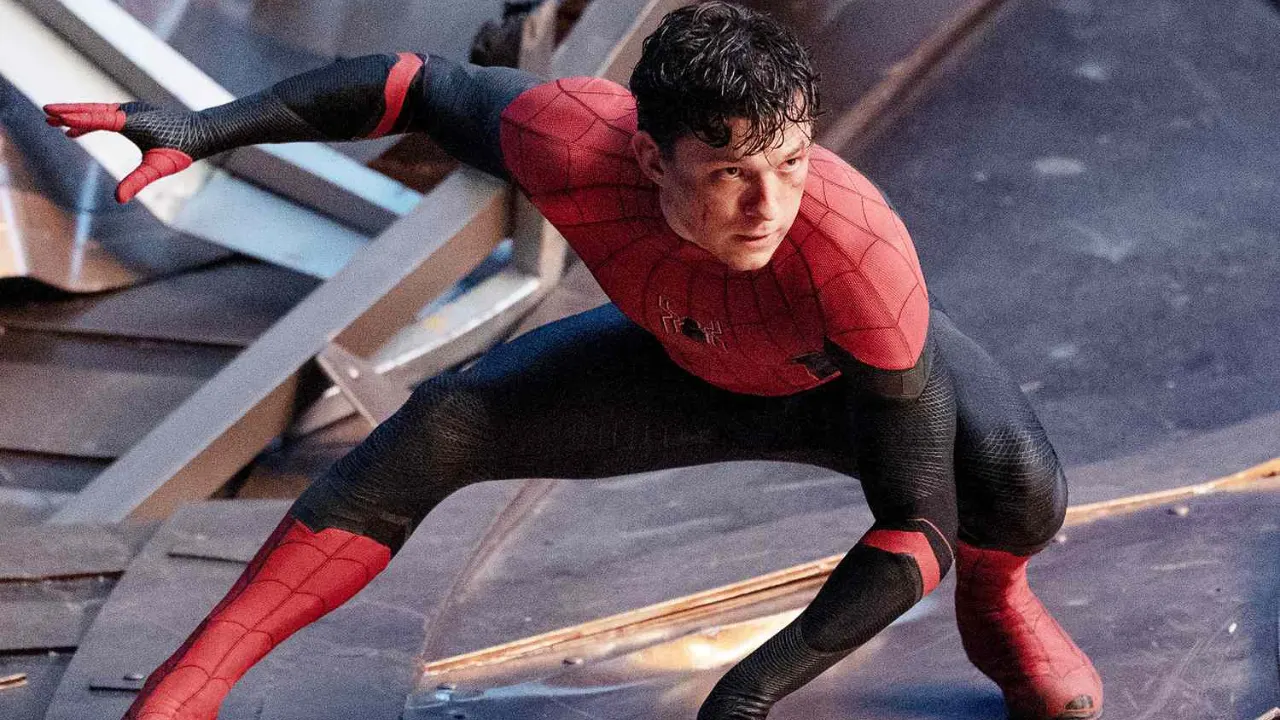
But the deeper inheritance was physical. Watch the way this Spider-Man occupies space. He crouches. He perches on things at angles that no stunt double schooled in wire work would arrive at instinctively, because they are not stunts, they are poses , the shapes Ditko drew, which no earlier film had bothered to reproduce because no earlier Spider-Man had been a trained acrobat and gymnast who had spent his adolescence learning where his limbs were. The swinging in these films is choreography. Holland dances it.
The cost of doing it yourself
In September 2025, on the set of Brand New Day, a stunt went wrong. Holland struck his head, was taken to hospital, was examined and released with a mild concussion. Production shut down for a week. Nobody else was hurt, and the release date never moved.
It is a small item in a trade paper, and it passed in a news cycle. I mention it because it is the shadow attached to everything I have just praised. The reason Holland's Spider-Man moves the way he does is that a great deal of the time it is actually him up there, and a man who insists on being the instrument eventually discovers that instruments break. There is something in this that rhymes uncomfortably with the character. Peter Parker's whole moral architecture is the conviction that if he does not personally do it, someone will be hurt. He is a boy who cannot delegate. Neither, it seems, is the actor.
"Brand New Day" and the arithmetic of a phenomenon
Destin Daniel Cretton's film opened on July 31, 2026, and the numbers arrived like weather. An opening day of $168 million, the largest ever recorded domestically. Thursday previews of $72 million, also a record. A three-day weekend of $355 million from 4,487 theatres , the second-largest domestic opening in history, some two million dollars behind Avengers: Endgame, a margin so thin it will be argued about by accountants for years. An A CinemaScore. Ninety percent on Rotten Tomatoes. The film did this, remarkably, without IMAX screens, which had been given over to Christopher Nolan's The Odyssey , a film in which Tom Holland also stars, and which held second place the same weekend with $51 million, the best third frame of Nolan's career.
One actor, two films, the biggest collective box-office weekend ever recorded. It is a species of dominance the movies produce perhaps twice a generation.
The picture itself picks up five years after No Way Home, with Peter erased from the memory of everyone alive, working as an anonymous volunteer crime-fighter in a New York that adores Spider-Man and has never heard of the man inside him. Cretton and the returning screenwriters Chris McKenna and Erik Sommers have made the sane decision to stop talking about the multiverse and start talking about grief. The Hollywood Reporter's David Rooney called it <cite index="40-1">a never-better Holland</cite>, and the consensus across the notices is that the actor has finally been handed the interior life he has been circling for a decade. IndieWire dissented, finding the film dull and downbeat while conceding that whatever emotional weather it achieves is Holland's doing.
I find the dissent as interesting as the praise. Both sides are describing the same thing: an actor who has outgrown the vehicle.
Telemachus, or the boy looking for his father
Consider what Holland has actually done this summer. In Nolan's film he plays Telemachus, a young man who has grown up without a father, who does not know whether the man is alive, and who leaves home to go looking for answers. Two weeks later he plays Peter Parker, a young man whose fathers keep dying , an uncle in a street, a mentor in a battlefield, an aunt on a floor , and who has now been orphaned a third time, from his own name.
This is not a coincidence so much as a casting director's understanding of what Holland does better than anyone in his generation. He plays yearning. He plays the specific, unglamorous ache of a young person who wants to be recognized by someone who is not there. The boyishness that critics keep flagging as a limitation is not a limitation; it is the subject. The Odyssey, he has said, was the job of a lifetime, and one suspects the education is visible in the Spider-Man film, which asks him to be quiet more often than any of the previous three.
He is thirty now. The clock that governs this role has been ticking since he put the suit on, and he knows it. Speaking on Happy Sad Confused while promoting the film, he confirmed that a transition has been mapped out: <cite index="21-1">there is a whole plan, worked on since they finished No Way Home</cite>, laid out, certain to change, but clear in outline. He has said he wants to be to his successor what Robert Downey Jr. was to him. He has floated Miles Morales, Spider-Gwen, the possibility of a Spider-Woman. Asked to name a young actor, he suggested Owen Cooper.
None of this reads as an exit. The film ends with a card promising, in the manner of the Bond pictures, that Spider-Man will return, and after a $355 million weekend no studio on earth is going to hurry him toward the door.
The image I am left with
There is a version of this story in which the interesting thing about Tom Holland is the money, and the tabloids, and the marriage to his co-star, and the summer in which two of his films devoured the world's screens simultaneously. That version will be written many times this month.
The image I keep is older and smaller. A boy of eleven, told no at an audition, going away and spending two years in ballet class so that the answer might be different. Everything that followed , the acrobat's crouch on the water tower, the somersault into frame, the willingness to keep doing his own falling until one of them put him in a hospital , is contained in that decision. He has spent a decade playing a character whose defining quality is that he does not stop, and the reason it is convincing is that he does not either.
Somewhere in a costume department in England there is a red and blue suit on a stand, waiting for whoever comes next. The lenses on the mask are closed. They are very good at looking like they are thinking.
💬 Discussion
0 comments