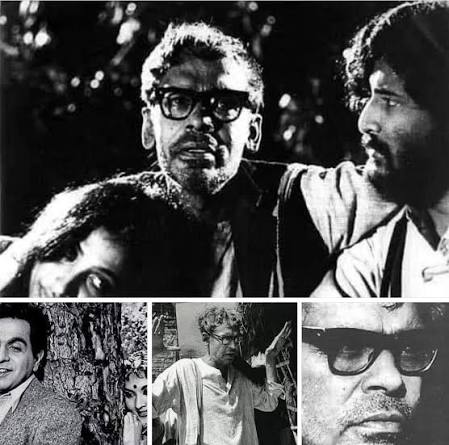
Ritwik Ghatak Made Six Films. Satyajit Ray Made Thirty-Six. History Gave Ray the Glory and Ghatak the Cult. Here Is the Honest Account of Why Ghatak Was the More Radical Filmmaker — and What Indian Cinema Lost When It Lost Him.
This is not an argument that Ghatak was a better filmmaker than Ray. Ray was one of the greatest directors who ever lived and that is not a claim this essay will contest. It is an argument that Ghatak was doing something different — something more violently original, something more formally daring, something more directly engaged with the specific wound of Partition — and that the comparative neglect of his work in the global cinephile conversation is a failure of critical attention that needs to be addressed.
Begin with the biographical fact that makes everything else legible.
Ritwik Ghatak was born in Dhaka in 1925. When Partition divided Bengal in 1947, his family's home became part of East Pakistan. He could not return. He spent the rest of his life in Calcutta as a refugee from a place that had ceased to exist in the form he had known it — a man carrying the specific grief of a homeland that was simultaneously accessible geographically and permanently lost culturally.
This grief — not as a theme but as a condition, as the lived reality from which every creative decision emerged — is the foundation of everything Ghatak made. His six major films are not films about Partition. They are films made by a person for whom Partition was not an event that had occurred but a wound that had not healed — a continuous, present-tense devastation that expressed itself in the fabric of his filmmaking at the level of form, not just content.
Satyajit Ray also made films in Bengal. He also worked through the specific textures of Bengali life and culture. But Ray's Bengal is, in some profound way, intact — a place that can be observed, documented, loved, mourned. Ghatak's Bengal is fractured. His films do not observe Bengal. They enact its fracture.
The formal radicalism — what he was doing that nobody else was doing
Ghatak's formal vocabulary is unlike anything else in Indian cinema before or since. It draws from Brecht's alienation effects, from the Japanese films he had seen, from the Bengali folk and classical music traditions he used in ways that created emotional dissonance rather than emotional comfort.
His use of sound is the most distinctive element of his filmmaking and the one least discussed in the standard accounts of his work. Ghatak used sound — music, ambient sound, the specific acoustic properties of spaces — in ways that deliberately refused the conventional relationship between sound and image.
In Meghe Dhaka Tara — the film that most fully realises his vision — the score shifts registers without warning, moving from folk melody to Western modernist dissonance to silence to ambient sound to heightened musical intensity within a single sequence. The effect is deeply unsettling — the emotional register the music is establishing does not correspond to the emotional register the images are establishing, and the gap between the two creates a specific quality of disturbance that no conventional film scoring can produce.
This is Brechtian in its effect — it prevents the viewer from settling into the comfortable identification that conventional cinema produces — but it is not Brechtian in its motivation. Ghatak was not using the alienation effect as an ideology. He was using it because it was the only form that could express what he needed to express — the specific quality of a grief that cannot be absorbed, that keeps interrupting the ordinary, that refuses to be assimilated into the flow of normal life.
Meghe Dhaka Tara — the film that contains everything
Meghe Dhaka Tara (1960) is Ghatak's most complete work and the film that most fully demonstrates both the specific quality of his genius and the reason he is so much harder to watch than Ray. A young woman — Nita — is the primary economic support of her refugee family in Calcutta. She works, sacrifices her own needs and desires for her family, is systematically exploited by each member of the family without their fully understanding what they are doing, and eventually becomes ill with tuberculosis and is sent to die in the hills.
This story, as Ghatak tells it, is not a narrative of victimhood or a political argument about the exploitation of women in Bengali refugee culture, though it is both of these. It is a formal enactment of the specific experience of a person for whom the world does not hold — for whom every effort to establish a stable position is undermined by forces that are simultaneously structural and contingent, external and internal.
The film's final scene — Nita in the hills, screaming that she wants to live — is one of the most unbearable sequences in cinema. Not because of its dramatic intensity, though the dramatic intensity is real. Because of its formal logic — because everything Ghatak has built across the preceding ninety minutes has been pointing toward this moment with an inevitability that makes the scream feel not like a dramatic climax but like a structural truth, like something that was always going to happen and that the film has been documenting rather than constructing.
Supriya Choudhury's performance in this scene — and across the entire film — is the best performance in Indian cinema and possibly the most underacknowledged great performance in world cinema. She is present in every scene with a quality of intelligence and suffering that makes Nita specific in the way that Ghatak's films require everything to be specific — not a type, not a symbol, but a person whose destruction the film insists you witness in full.
The three films that complete the picture
Komol Gandhar (1961) and Subarnarekha (1962) complete what critics have called the Partition Trilogy, though Ghatak himself did not use this term. Each film extends the formal vocabulary of Meghe Dhaka Tara and each addresses a different aspect of the refugee experience — the loss of cultural continuity in Komol Gandhar, the specific violence done to people who have no place in the new order in Subarnarekha.
Jukti Takko Aar Gappo (1974) — his last completed film — is the most directly autobiographical thing he made. He plays himself — an alcoholic intellectual unable to find his place in a changing Bengal — in a film that is simultaneously a reckoning with his own failures and a final statement of the principles that had governed his work. Made when he knew he was dying, it has the specific quality of a man settling his accounts with himself and finding the settlement inadequate and saying so.
Why he is less known than he should be — the honest account
Ghatak is less known internationally than Ray for reasons that are structural rather than aesthetic. Ray was the filmmaker who made Indian cinema legible to international audiences — who found forms and subjects that could travel across cultural barriers without requiring the specific knowledge of Bengali life and culture that his films drew on. Ghatak made films that are less translatable — that require more of the viewer in terms of cultural context and formal patience.
This is not a failure. It is a specific quality of his work that corresponds to a specific quality of the experience he was documenting. The Partition wound is not a wound that translates cleanly. The specific grief of being a refugee from a place that still exists but is no longer yours is not an experience that universalises easily. Ghatak's formal radicalism — the dissonant sound, the interrupted narrative, the refusal of consolation — is the formal equivalent of an experience that resists the smoothing that international recognition requires.
What Indian cinema lost when it lost Ghatak — he died in 1976 at fifty-one — was not simply a filmmaker. It was a formal tradition that has no successors in the full sense. Kiarostami's formal rigour, the Romanian New Wave's moral seriousness, the Dardenne Brothers' ethical commitment to the specific — all of these are related to what Ghatak was doing and none of them is doing exactly what he was doing. The specific combination of formal radicalism, emotional intensity, and cultural specificity that defines his work is unrepeatable. Watch the six films. They exist. They are available. That is enough.
💬 Discussion
0 comments