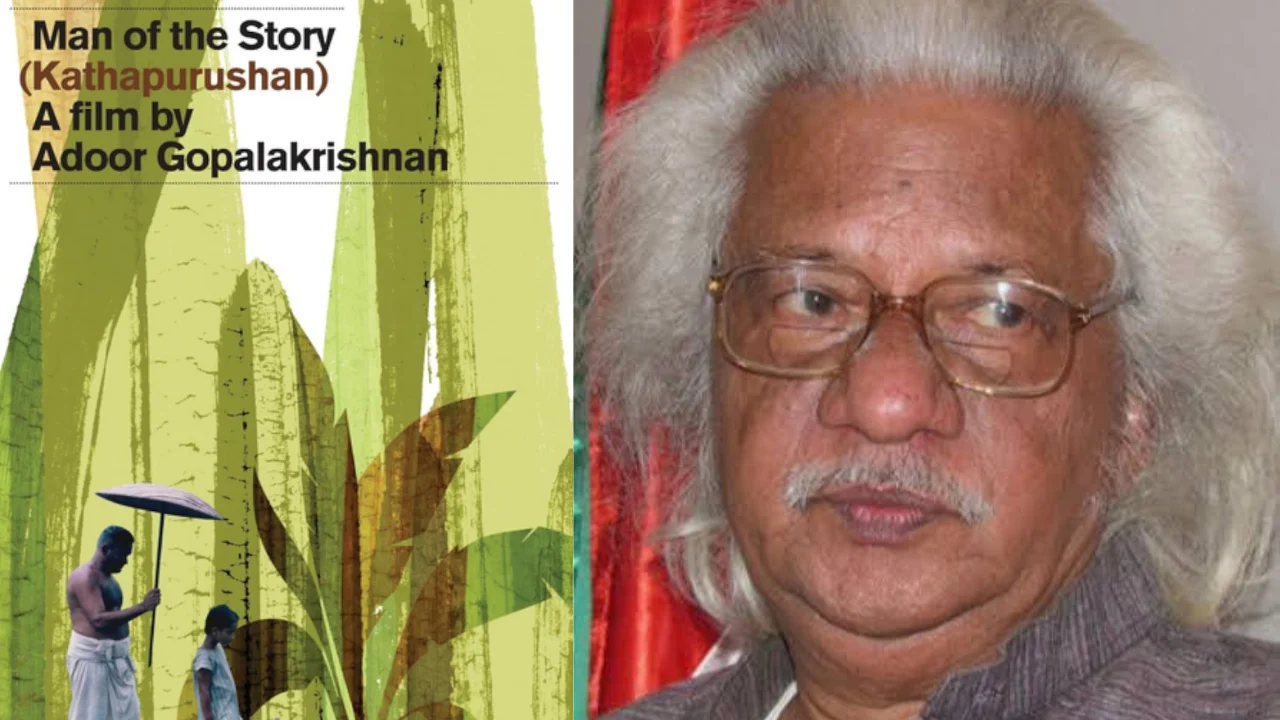
There is a moment in Adoor Gopalakrishnan’s Elippathayam (Rat-Trap, 1981) that distills the essence of his entire cinema. A middle-aged man named Unni, the last inheritor of a decaying feudal household in Kerala, sits immobile in his ancestral home as life slowly passes him by — his sisters leaving one by one, the house crumbling around him, the old world to which he belongs dissolving into modernity. He cannot act. He cannot change. He is not a villain; he is simply a man for whom time has stopped, and the tragedy is both personal and historical. When the British Film Institute named Elippathayam the most original and imaginative film of 1982, it was acknowledging a filmmaker who had achieved, in the quiet intensity of a single Malayalam film set in rural Kerala, something that spoke to the universal human condition.
Adoor Gopalakrishnan is India’s greatest living filmmaker. In a career spanning more than five decades and comprising just twelve feature films, he has produced a body of work whose moral seriousness, formal beauty, and intellectual depth places him in the company of the world’s masters — alongside Bergman, Bresson, Ozu, and Tarkovsky. He is unhurried, uncompromising, and utterly himself. He does not make films to entertain (though his films have their own austere pleasure), and he does not make films to deliver messages. He makes films to understand — to examine, with microscopic precision and deep compassion, the society he was born into and the human beings who inhabit it.
His importance to Indian cinema cannot be overstated. Gopalakrishnan did for Malayalam cinema what Satyajit Ray did for Bengali cinema: he transformed it. Before Swayamvaram (One’s Own Choice, 1972), Malayalam cinema was largely a domain of melodrama, mythological spectacle, and social messages delivered with a heavy hand. After Swayamvaram, a new kind of cinema was possible — one rooted in real lives, real spaces, real feelings, free of artifice and theatrical excess. The New Wave he launched in Kerala produced one of the richest regional film cultures in the world: Aravindan, K.G. George, P. Padmarajan, Bharathan, Shaji N. Karun, and many others owe their artistic freedom, in part, to the cultural infrastructure Gopalakrishnan built. His place in the history of Indian filmmaking is as the supreme architect of South Indian art cinema — the director who proved, incontrovertibly, that a film made in Malayalam about the feudal history of Kerala could be as significant as any film made anywhere in the world.
Early Life and Influences Mouttathu Gopalakrishnan Unnithan was born on 3 July 1941 in Mannadi, a small village in the Adoor area of what is now Kerala’s Pathanamthitta district. He later took the name of this village as his professional surname — “Adoor” Gopalakrishnan — a practice common among Keralites that signals deep attachment to place of origin. His family were patrons of Kathakali, the highly stylized classical dance-drama form of Kerala — one of the most demanding and sophisticated performance traditions in India. Growing up in a household where Kathakali performances were part of life, Gopalakrishnan absorbed from childhood an education in the art of telling stories through the body, through coded gesture and facial expression, through the relationship between performer and space.
He began acting in amateur theatre at the age of eight. Through his school and college years he produced and directed over twenty plays, several of which he wrote himself. This theatrical grounding — an understanding of how performance and narrative structure work together — would prove foundational to his approach as a filmmaker. He is, at his core, a director’s director: someone who thinks in terms of the total work, who understands that every decision — the position of a camera, the duration of a shot, the exact moment an actor looks up — is a storytelling decision.
He pursued his undergraduate education at the Gandhigram Rural Institute in Dindigul, Tamil Nadu, graduating in 1960 with a degree in Economics, Political Science, and Public Administration — a combination that gave him analytical frameworks for understanding society that would directly feed the sociopolitical intelligence of his films. He worked briefly as a statistical investigator for the government before deciding to commit fully to cinema.
In 1962, Gopalakrishnan enrolled at the Film and Television Institute of India (FTII) in Pune, the newly established national film school that would train an entire generation of Indian filmmakers who would transform their regional cinemas. He studied Screenplay Writing and Advanced Film Direction, graduating in 1965. The FTII was a crucible of cinematic education — its library held films from around the world, and students were exposed to Italian neorealism, French New Wave, Soviet cinema, and the work of international masters that most Indian filmmakers of the time had never encountered. For Gopalakrishnan, this was a revelation. He arrived already shaped by Kathakali and theatre; he left understanding that cinema, at its best, could combine the precision of classical form with the freedom of lived experience.
Three influences proved most formative in his cinematic vision. The first was Italian neorealism — particularly Vittorio De Sica and Roberto Rossellini — with its insistence on real locations, non-professional actors, social truth, and the poetry of the ordinary. The second was the work of Satyajit Ray, whose Pather Panchali had already demonstrated that this kind of cinema was possible in India and that it could speak universally. The third, more unusual, was the Japanese director Yasujirō Ozu, whose patient observational camera, deep attachment to family and domestic space, and profound melancholy about the passing of old ways of life resonated powerfully with Gopalakrishnan’s own concerns about Kerala’s transition from a feudal to a modern society.
Directorial Vision and Philosophy
Gopalakrishnan’s cinema is animated by a single, sustained preoccupation: the transition of Kerala from its feudal past into modernity, and the human cost — psychological, social, moral — of that transition. This is not merely a historical interest. It is an excavation of identity: who are we when the world we were formed by no longer exists? What survives, and at what price?
Several major thematic concerns run through his entire body of work:
The decay of feudalism and the crisis of masculinity. In film after film — Elippathayam, Kodiyettam (Ascent, 1977), Vidheyan (The Servile, 1993) — Gopalakrishnan examines men who have been formed by a feudal social order that is dying beneath them. These men are not simple victims; they are complicit in their own destruction. Unni in Elippathayam clings to the ancestral house even as it traps him. The master in Vidheyan exercises cruelty because dominance is the only language he has. The returning Communist hero of Mukhamukham (Face to Face, 1984) retreats into alcoholism because he cannot inhabit a world that has moved beyond the idealism that gave his life meaning. These portraits of masculinity in crisis are among the most psychologically precise in Indian cinema.
The search for self and home. Many of Gopalakrishnan’s characters are people in search of a stable identity — a sense of who they are in a world that no longer provides the old answers. The young couple of Swayamvaram leave their families to make a life of their own choosing, only to find that freedom is more costly than they imagined. Unnikrishnan in Anantaram (Monologue, 1987) reconstructs his identity through memory and storytelling. Basheer in Mathilukal (Walls, 1990) is physically imprisoned but maintains his humanity through the power of imagination.
Power, servitude, and the psychology of oppression. Vidheyan is Gopalakrishnan’s most brutal film — a study of how power corrupts both the master who exercises it and the servant who internalizes it. The title character, Pathros, a tribal man from an impoverished background, becomes so thoroughly dominated by his upper-caste employer Thomas Chacko that he loses his capacity for independent agency entirely. The film asks one of the most uncomfortable questions in Indian social life: how does centuries of hierarchical oppression shape the inner life of the oppressed?
Women’s confinement and resistance. Gopalakrishnan is one of Indian cinema’s most subtle portrayers of women’s experience. In Naalu Pennungal (Four Women, 2007), he gives four separate stories entirely to women characters, exploring with great intimacy the ways women navigate, resist, and are shaped by patriarchal social structures. His women are never passive: they are constrained, but within constraint they find strategies of survival and, occasionally, liberation.
Failed idealism and the limits of politics. Mukhamukham is his most overtly political film — a devastating examination of the decline of the Communist movement in Kerala from revolutionary aspiration to institutional complacency. The film does not condemn Communism; it mourns its betrayal of its own ideals. This ambivalence — neither cynicism nor naivety about political movements — is characteristic of Gopalakrishnan’s mature thought.
Memory, consciousness, and the nature of storytelling. In his later work, particularly Anantaram and Kathapurushan (Man of the Story, 1995), Gopalakrishnan becomes increasingly interested in the reflexive question of how we construct our own narratives — how memory is not a record but a creation, how identity is something we tell rather than something we have.
His philosophical worldview is essentially humanist and rationalist, shaped by the democratic idealism of Kerala’s progressive social movements, but free of ideology. He is too honest an observer to be an ideologue. He sees the Communist movement with the same clear-eyed complexity with which he sees feudal patriarchs — recognizing what is admirable while refusing to excuse what is not.
Signature Style
Gopalakrishnan’s visual language is among the most distinctive in Indian cinema — and among the most restrained. He is, in the language of film aesthetics, a minimalist: a filmmaker who achieves maximum expressive effect through reduction rather than accumulation.
Visual style and cinematography. Gopalakrishnan’s frames are carefully composed but never showy. He favours the medium shot and the long take — the camera placed at a respectful distance from its subjects, observing rather than intruding. His collaboration with cinematographers Ravi Varma and later P. Radhakrishnan produced images of extraordinary textural richness: the moist darkness of ancestral homes, the green intensity of Kerala’s landscapes, the quality of light through coconut palms. His visual language draws on the Kathakali tradition — the use of space, the significance of threshold and boundary, the face as landscape — but translates it into cinematic form. He is exceptionally attentive to architecture as social meaning: the decaying ancestral tharavad (family home) in Elippathayam is not a backdrop but a character, the physical embodiment of a dying social order.
Sound and music. Gopalakrishnan’s use of sound is exceptional. He uses ambient sound — rain, insects, wind, distant human activity — as compositional elements, not merely atmospheric texture. Music is used sparingly and with great precision; he tends toward silence or natural soundscapes rather than orchestral underscoring. This silence is expressive: it creates a space of reflection in which the viewer is asked to sit with what they have seen rather than being emotionally directed by a score.
Handling of actors. Gopalakrishnan has a deeply specific theory of screen acting, distinct from the theatrical mode that dominated Indian cinema. He has stated: “In movies, the actor is not performing to the audience like the stage actor. Here they are acting for me. I am the audience and I will decide whether it is correct or not, enough or not.” This approach produces performances of extraordinary internality — actors who seem genuinely inhabited rather than displayed. His collaboration with Bharat Gopi (who appeared in four of his films) produced performances — particularly in Elippathayam — that are among the finest in Indian cinema. His direction of Mammootty in Mathilukal extracted from that famously extroverted star a performance of heartbreaking restraint.
Narrative structure and pacing. Gopalakrishnan is the master of slow cinema in the Indian context. His films move at the pace of life rather than the pace of drama — they accumulate meaning through repetition, through the patterning of seemingly ordinary events, through the gradual revelation of what was always present but not yet visible. In Elippathayam, the film’s central metaphor — the rat trap of the title — is not stated but enacted: the viewer comes to understand Unni’s imprisonment not through any dramatic crisis but through the accumulation of tiny details that, over time, become overwhelming. This demands patience from the viewer but rewards it with a depth of understanding that dramatic cinema cannot provide.
Screenplay and adaptation. Gopalakrishnan writes all his own screenplays. His scripts for original work — Elippathayam, Mukhamukham, Kathapurushan — demonstrate a dramaturgical intelligence that uses ellipsis and indirection with great sophistication: what is left out is as important as what is shown. His literary adaptations — Mathilukal from Vaikom Muhammad Basheer, Nizhalkkuthu (Shadow Kill, 2002) from a concept by Vijayan — are faithful to spirit rather than letter, finding the cinematic equivalents of literary effects rather than simply illustrating text.
Major Films
Swayamvaram (One’s Own Choice, 1972)
Gopalakrishnan’s debut announced a completely new Malayalam cinema with the confidence of a fully formed master. The film follows Vishwanathan and Sita, a young couple who leave their families to live together — an act of individual choice against social convention — and find that freedom is inseparable from economic precarity and emotional isolation. Set in Thiruvananthapuram, the film was shot entirely on location, using natural light, with restraint and understatement that was wholly unprecedented in Malayalam cinema.
The film’s significance was immediately recognized. It won four National Film Awards, including Best Film and Best Direction, and announced to the Indian film world that Malayalam cinema had found its own voice. In Kerala, its impact was seismic: Swayamvaram did not merely succeed as a film; it redefined what a Malayalam film could be, and opened the door for the New Wave directors who would follow.
Kodiyettam (Ascent, 1977)
Gopalakrishnan’s second film — made five years after his first, a patience that would characterize his entire career — is set in rural Kerala and follows Shankaran Kutty, a feckless, lovable young man who lives in a state of pleasant but meaningless drift: drinking, making mischief, resisting all attempts by his family and community to give his life purpose. The film is a deceptively gentle character study that opens, over time, into a meditation on what it means to grow up — to move from a life of pure sensation to a life of moral responsibility.
Bharat Gopi’s performance as Shankaran Kutty is extraordinary: he makes this thoroughly unremarkable man one of the most vivid presences in Indian cinema. Kodiyettam won the National Award for Best Direction and established Gopalakrishnan as not merely a promising debut director but a master of sustained characterization.
Elippathayam (Rat-Trap, 1981)
This is Gopalakrishnan’s masterpiece — one of the greatest films in Indian cinema and a work of world significance. Set in the 1940s Kerala countryside, the film follows Unni, the last male heir of a declining feudal family, and his two sisters. The ancestral home is literally falling apart; the family’s landholdings are diminishing; the social world that gave the tharavad its meaning has dissolved. Unni is incapable of adaptation: he sleeps too much, eats too much, and regards the world outside his home with vague anxiety. His older sister Rajamma is the practical, hardworking one who keeps the household alive. His younger sister Pennu eventually escapes — walks out of the house and into modernity, into a love affair, into life.
The film’s central metaphor — the rat trap, a traditional device used to catch rats on Kerala’s paddy fields — operates on multiple levels simultaneously: Unni is trapped by his house, his class, his gender role, his historical moment. But the trap also catches the viewer: we come to understand Unni’s predicament so intimately that we cannot simply condemn him. He is pitiable and complicit at once.
The British Film Institute named Elippathayam the most original and imaginative film of 1982 — a distinction that had previously been given to only one Indian director: Satyajit Ray. The comparison was apt and acknowledged. Gopalakrishnan had achieved, within the specific geography and history of Kerala, a film as universal in its resonance as anything in world cinema.
Mukhamukham (Face to Face, 1984)
Gopalakrishnan’s most politically engaged film is also one of his most complex and disturbing. A charismatic Communist trade union leader named Subramanian — a figure who had inspired an entire generation’s idealism — disappears for years and returns as a degraded alcoholic. The film explores the collective psychology of disillusionment: what happens to a community when its ideals are embodied in a person who then fails? The response of Subramanian’s former colleagues — their oscillation between the need to believe and the evidence before their eyes — is a portrait of the way ideology and personal loyalty interact that has few equivalents in Indian cinema.
Mukhamukham won the FIPRESCI prize at an international festival and remains one of the most important political films in Indian cinema — not because it espouses a political position, but because it examines the psychology of political commitment with ruthless honesty.
Mathilukal (Walls, 1990)
Based on the beloved Malayalam writer Vaikom Muhammad Basheer’s autobiographical novella, Mathilukal is Gopalakrishnan’s most formally audacious film and one of his most beautiful. The setting is a prison in Kerala during the period of the king’s rule. Basheer — the actual historical writer, played by Mammootty in a performance of astonishing delicacy — falls in love with Narayani, a woman imprisoned on the other side of a high wall. He never sees her. She is present in the film only as a voice — a laugh, a word, a song carried over the wall.
The film is a study in the power of imagination to transcend physical constraint. The wall that separates Basheer from Narayani is simultaneously a prison wall, a social wall (the purdah that separates men and women in a conservative society), and a metaphysical wall — the barrier between the self and the other that love attempts to dissolve. Gopalakrishnan’s achievement is to make the invisible woman more vivid and present than most visible characters in Indian cinema. The film is a meditation on longing, on the prison of convention, and on the redemptive power of the imagination. It premiered at Cannes and received universal acclaim.
Vidheyan (The Servile, 1993)
Gopalakrishnan’s most disturbing film is a parable about power so unflinching that it remains difficult to watch. Pathros, a poor tribal man, becomes completely enslaved — psychologically, spiritually, personally — to Thomas Chacko, a wealthy and brutal upper-caste landlord. The film traces this enslavement with clinical precision: how a person, through years of subordination, gradually loses the capacity for independent selfhood. When Chacko commands, Pathros obeys — even when the commands are humiliating, even when they involve watching his wife being abused, even when they require the erasure of everything that was once his own.
The film is not primarily about caste, though caste is its social context. It is about the psychology of power — how domination works, how it reproduces itself, how it shapes both the dominant and the dominated in ways neither can easily escape. It is one of the most uncomfortable and necessary films in Indian cinema.
Nizhalkkuthu (Shadow Kill, 2002)
Set in the period of the Kingdom of Travancore, Nizhalkkuthu follows Kaliyappan, a hereditary executioner who begins to doubt the justice of the capital punishment system he serves. The film is Gopalakrishnan’s most philosophical: a meditation on individual conscience against institutional authority, on the moral weight of violence performed in the name of law, and on what it means to carry the burden of another person’s death. The film premiered at Venice and won international recognition, affirming that Gopalakrishnan’s cinema remained, after three decades, among the most morally serious in the world.
Contribution to Indian Cinema
Gopalakrishnan’s contribution to Indian cinema is architectural as much as artistic. He did not merely make great films; he built the structures through which great films could be made in Kerala.
Founding the Chitralekha Film Cooperative. In 1965, immediately after graduating from FTII, Gopalakrishnan took the initiative to found the Chitralekha Film Society of Trivandrum and then, in 1966, the Chitralekha Film Cooperative — India’s first cooperative society for film production, distribution, and exhibition. This was not a small act. At the time, Malayalam cinema was almost entirely in the hands of commercial producers who had no interest in the kind of films Gopalakrishnan wanted to make. By creating a cooperative that received state support, he established the institutional foundation for an entirely alternative cinema. The Chitralekha cooperative produced Swayamvaram and became the nursery from which the Malayalam New Wave grew: G. Aravindan, P.A. Becker, K.G. George, Pavithran, and Raveendran all made films within the cultural space Gopalakrishnan had created.
Launching the New Wave in Malayalam cinema. The New Wave that Swayamvaram initiated transformed Malayalam cinema from a regional popular industry into one of the world’s most sophisticated filmmaking cultures. The directors it produced in the 1970s and 1980s — Aravindan, George, Padmarajan, Bharathan, Shaji N. Karun — created a body of work that stands comparison with the best of world cinema. None of this would have been possible without the cultural and institutional groundwork Gopalakrishnan laid.
Establishing Malayalam cinema internationally. Before Gopalakrishnan, Malayalam cinema was invisible on the international festival circuit. After him, it became one of the most respected regional cinemas in the world: films premiered routinely at Venice, Cannes, Berlin, and Toronto. He opened the door, and subsequent generations walked through it.
Raising standards for the entire industry. Gopalakrishnan’s uncompromising standards — for screenplay, performance, cinematography, and sound — raised expectations across Malayalam cinema. Even commercial directors, in the New Wave’s wake, were compelled to work at a higher level of craft. The remarkable richness of Malayalam cinema in the 1980s and 1990s — including the work of directors who were primarily popular entertainers — owes something to the elevation of standards that Gopalakrishnan and his peers achieved.
Relationship with Society and Culture
Gopalakrishnan is a filmmaker of a specific place — Kerala — in a way that is as defining as Ray’s Calcutta. His films are saturated with the specific textures of Kerala’s landscape, social history, architecture, performing arts, and political culture. The tharavad, the matrilineal inheritance system, the influence of Kathakali, the Communist political tradition, the complex caste structure of a society that was both highly literate and deeply stratified — all of these are present in his films not as ethnographic documentation but as living social reality.
His relationship with Kerala’s Communist tradition is particularly interesting. He is not a Communist filmmaker in the manner of Mrinal Sen, but he is clearly a product of Kerala’s progressive intellectual culture, and his films engage seriously with the promise and failure of Left politics in Kerala. Mukhamukham is the most direct expression of this engagement, but the sense that social structures matter, that history shapes individual psychology, that power is never innocent, runs through all his work.
His treatment of gender is similarly nuanced. He is not a feminist filmmaker in any programmatic sense, but his films consistently treat women’s interiority and social constraint as subjects of the highest seriousness. Naalu Pennungal — an anthology of four stories about women — represents the most concentrated expression of this concern, but women’s experience is present throughout his work as a site of both suffering and resistance.
On religion, Gopalakrishnan adopts the stance of a secular humanist: he acknowledges the pervasive presence of religion in Kerala’s social life without either celebrating or condemning it. Religion appears in his films primarily as it shapes social behavior — as a source of community and identity, but also of hierarchy and constraint.
Strengths and Limitations
Strengths: - Mastery of the long take and observational cinema: unmatched in Indian cinema for the ability to create meaning through duration and spatial relationship. - Psychological depth: the most precise analyst of inner life in Indian film, capable of portraying states of consciousness — paralysis, servitude, disillusionment — that most filmmakers cannot approach. - Social intelligence: a filmmaker who understands, from the inside, the social forces that shape his characters, and who never reduces characters to their social positions. - Institutional vision: the only Indian filmmaker of his generation to build, alongside his creative work, the institutional structures needed to sustain an alternative cinema. - Formal consistency: every element of his films — image, sound, performance, music, production design — operates as part of a unified whole.
Limitations and criticisms: - Narrowness of canvas: Gopalakrishnan’s films are almost entirely set in Kerala and draw on a specific stratum of Keralite experience — the nair feudal middle class and its specific social history. His engagement with tribal life, urban modernity, or the experience of Kerala’s Christian and Muslim communities, while present in specific films, is limited compared to his deep intimacy with the dominant-caste Hindu social world. - Pace and accessibility: his films demand a patience and a willingness to sit with uncertainty that many viewers — even art-cinema audiences — find difficult. This is not a failure of the films, but it does limit their reach. - Small body of work: twelve feature films over five decades is an extraordinarily small output. His perfectionism, and the difficulty of financing genuinely independent work in India, has meant that there are long gaps between films during which his influence could not be refreshed by new work. - The difficulty of the later films: critics have noted that his later work, particularly Naalu Pennungal and Oru Pennum Randaanum, while formally sophisticated, lacks the concentrated power of Elippathayam or Mathilukal.
Awards and Recognition
National Film Awards (India): 16 National Film Awards — the third highest total among Indian directors, after Satyajit Ray and Mrinal Sen. His awards span Best Film, Best Direction, Best Screenplay, and several special jury recognitions.
Kerala State Film Awards: 17 Kerala State Film Awards — the highest number won by any director in the history of the award.
International recognition: - British Film Institute Award for most original and imaginative film of 1982 for Elippathayam — the only Indian director after Ray to receive this honour. - FIPRESCI Prize (International Federation of Film Critics) for Mukhamukham (1984). - Films premiered at Venice, Cannes, Berlin, Toronto, London, and major international festivals across five decades. - Retrospectives held in Pesaro, Helsinki, La Rochelle, Nantes, Munich, New York, and other international centres.
Lifetime honours: - Padma Shri (1984) — Indian civilian honour. - Padma Vibhushan (2006) — India’s second-highest civilian honour. - Dadasaheb Phalke Award (2004) — India’s highest honour for lifetime achievement in cinema, widely considered the Indian equivalent of an Honorary Oscar. - Commander of the Order of Arts and Letters, France (2004) — the highest French cultural honour, recognizing his contribution to international cinema. - J.C. Daniel Award (2016) — Kerala government’s highest honour for contribution to Malayalam cinema. - Honorary Doctorates from Mahatma Gandhi University, University of Kerala, and the University of Wisconsin-Milwaukee, which established the Adoor Gopalakrishnan Film Archive and Research Center.
Influence and Legacy
Gopalakrishnan’s influence on Malayalam cinema is total. Every Malayalam filmmaker who works in the tradition of social realism, psychological depth, and formal restraint — and this tradition has produced some of the most celebrated films in Indian cinema over the past fifty years — is indebted to the world he created.
More specifically, the Malayalam directors most directly shaped by his work include G. Aravindan (who shared Gopalakrishnan’s FTII background and his commitment to visual poetry), K.G. George (whose brilliant genre-inflected social dramas were enabled by the cultural space the New Wave created), Shaji N. Karun (whose Vanaprastham won international acclaim at Cannes), T.V. Chandran (the most politically radical of the New Wave’s inheritors), and, in the contemporary period, Lijo Jose Pellissery and others who work in the tradition of distinctly Keralite cinema.
His influence extends beyond Malayalam: Shyam Benegal has acknowledged Gopalakrishnan’s impact on his understanding of what Indian regional cinema could achieve. The current generation of pan-Indian art-cinema filmmakers — Chaitanya Tamhane, Raam Reddy, Rohena Gera — work in a tradition that Gopalakrishnan helped to define. Internationally, his films — particularly Elippathayam and Mathilukal — are taught in film schools across the world as exemplary cases of how to achieve psychological complexity through formal minimalism. The University of Wisconsin-Milwaukee’s decision to establish a dedicated archive and research center in his name marks the degree to which his work has become part of the canon of world cinema studies.
Critical Evaluation
Is Adoor Gopalakrishnan primarily an artist, an entertainer, an innovator, or an industry-builder? The honest answer is that he is all four — but in a very specific proportion. He is, first, an artist of the highest order: his films are works of personal vision, moral seriousness, and formal intelligence that belong to the tradition of great world cinema. He is an innovator in the sense that he brought methods and attitudes to Malayalam cinema that were entirely new, and that permanently transformed the industry. He is an industry-builder in the institutional sense: the Chitralekha cooperative, the film society movement, his advocacy for state support of alternative cinema — these were not incidental to his artistic work but foundational to it. He is not primarily an entertainer, though the best of his films offer deep pleasures.
Compared to his contemporaries, he stands in a singular position within South Indian cinema. He is the only director from the non-Bengali, non-Hindi cinemas who belongs, without qualification, in the very first rank of Indian filmmakers. Mani Ratnam is more widely beloved and more commercially successful; Shankar has had greater impact on the mainstream industry; but Gopalakrishnan is the only South Indian director who can be mentioned alongside Ray and Ghatak without any diminishment of the comparison.
Among world directors, he is the true heir to the tradition of Robert Bresson — the filmmaker who believed that less is always more, that the camera should observe rather than manipulate, that truth in cinema comes from reduction rather than accumulation. His films have the quality that Bresson’s work has: an austerity that is not coldness but precision, a refusal of easy emotion that makes the genuine emotion, when it finally comes, overwhelming.
Conclusion
Adoor Gopalakrishnan spent his career doing something that is both simple to state and extraordinarily difficult to achieve: making films about the society he knew, with absolute honesty and formal intelligence, for the love of cinema as an art form. He did not make compromises. He did not seek commercial success. He was not interested in the language of popular entertainment. He built, alongside his creative work, the institutional structures that made genuine independence possible, and he made twelve films that will endure for as long as cinema is watched and studied.
For future generations, his films are essential study — not merely as historical documents of Kerala’s social transformation, but as models of how to use cinema’s specific capacities: the long take, the observational camera, the actor’s face held in silence, the accumulated weight of ordinary detail. He showed that cinema, at its best, is an instrument of understanding rather than a machine of emotion — that the most profound filmic experience is not the one that makes you cry but the one that makes you see.
Selected Filmography
| Year | Film (Malayalam Title) | English Title | Awards/Notes |
| 1972 | Swayamvaram | One’s Own Choice | National Award: Best Film, Best Direction; launched Malayalam New Wave |
| 1977 | Kodiyettam | Ascent | National Award: Best Direction, Best Actor (Bharat Gopi) |
| 1981 | Elippathayam | Rat-Trap | British Film Institute Award (1982); most celebrated film |
| 1984 | Mukhamukham | Face to Face | FIPRESCI Prize; political masterpiece |
| 1987 | Anantaram | Monologue | National Awards; Cannes premiere |
| 1990 | Mathilukal | Walls | National Awards; Cannes premiere; Mammootty’s finest performance |
| 1993 | Vidheyan | The Servile | National Awards; Venice premiere |
| 1995 | Kathapurushan | Man of the Story | National Award: Best Film; Venice premiere |
| 2002 | Nizhalkkuthu | Shadow Kill | Venice premiere |
| 2007 | Naalu Pennungal | Four Women | National Awards |
| 2010 | Oru Pennum Randaanum | A Woman and Two Sons | |
| 2016 | Pinneyum | Once Again | His return to features after a 6-year gap |
Recommended Viewing List (10 Films)
For those approaching Gopalakrishnan for the first time, this sequence moves from his most accessible work toward his most demanding:
- Swayamvaram (1972) — Start here: the film that started everything.
- Kodiyettam (1977) — Bharat Gopi’s greatest performance; a portrait of slow human growth.
- Elippathayam (1981) — His masterpiece: one of the great films of world cinema.
- Mathilukal (1990) — His most imaginatively audacious film; Mammootty unforgettable.
- Mukhamukham (1984) — For its political depth; the best film about ideological disillusionment in Indian cinema.
- Vidheyan (1993) — Disturbing, necessary; his most direct treatment of power and servitude.
- Kathapurushan (1995) — His most personal film; memory and identity interwoven.
- Kodiyettam again — It rewards second viewing once you understand his formal language.
- Nizhalkkuthu (2002) — His most philosophical film; for viewers who have seen the earlier work.
- Naalu Pennungal (2007) — For his treatment of women; four portraits of extraordinary depth.
Complementary viewing: To understand the world Gopalakrishnan created, watch G. Aravindan’s Thampu (1978) and Kanchana Sita (1977), and Shaji N. Karun’s Piravi (1989) — all products of the New Wave he initiated.
Further Reading and References
Books: - The Films of Adoor Gopalakrishnan: A Cinema of Emancipation by Suranjan Ganguly (Anthem Press, 2015) — The most comprehensive critical study of his work. - The World of Cinema by Adoor Gopalakrishnan (1983) — Ray’s own reflections; won a National Award. - Encyclopedia of Indian Cinema by Ashish Rajadhyaksha and Paul Willemen — Essential context for the Kerala New Wave.
Essays and Articles: - Meenaxi Tyagi, “The Feudal Allegory in Elippathayam,” Journal of South Asian Film Studies, 2009. - Wimal Dissanayake, “Adoor Gopalakrishnan: The Aesthetic World of an Indian Auteur,” in Colonialism and Nationalism in Asian Cinema (1994). - Premankur Biswas, “Adoor Gopalakrishnan: A Worthy Heir to Satyajit Ray’s Tradition,” Sahapedia, 2017.
Film Resources: - The Adoor Gopalakrishnan Film Archive at the University of Wisconsin-Milwaukee holds his complete filmography. - Several of his films are available on MUBI and the National Film Archive of India (NFAI) streaming platforms. - The Kerala State Chalachitra Academy has produced extensive documentation of the New Wave period.
💬 Discussion
0 comments