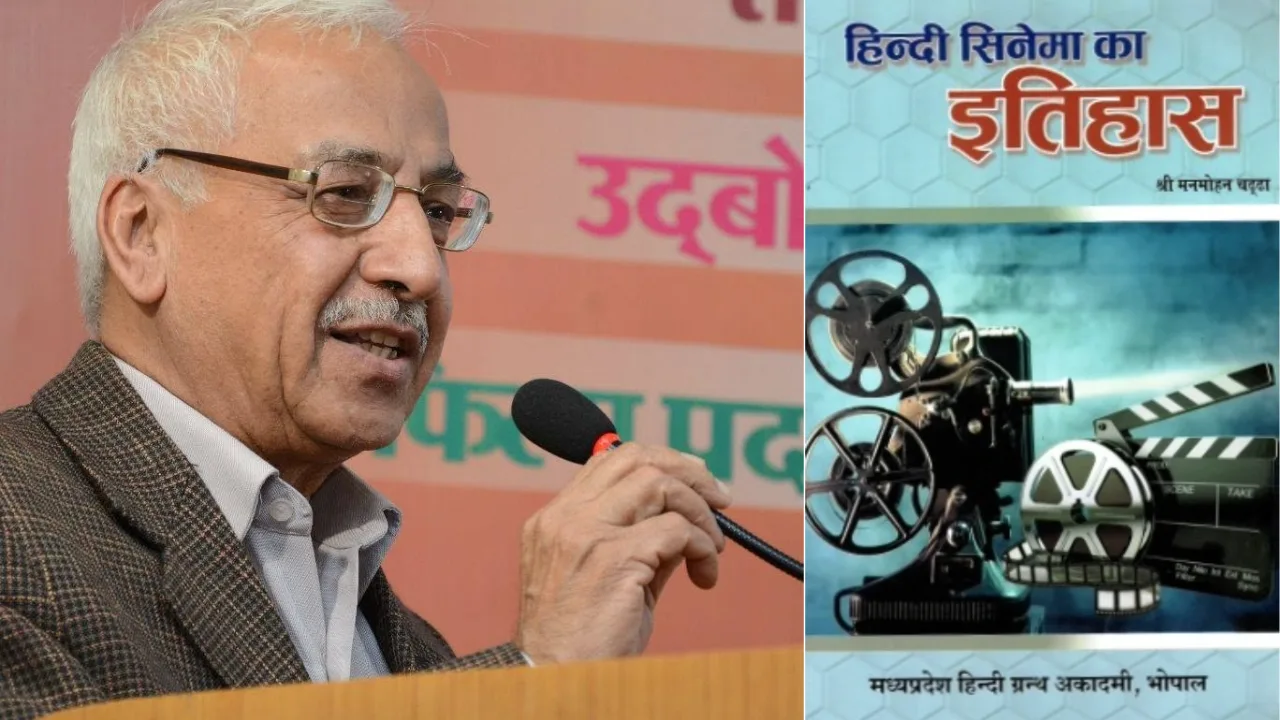
Among this distinguished but often overlooked fraternity stands Manmohan Chadha, one of India's most significant film critics, historians and educators. For more than four decades, Chadha has devoted his life to understanding cinema not merely as entertainment but as an art form, a historical document, and a language that deserves careful study. His contribution extends far beyond reviewing films. Through his books, teaching, lectures and public engagement, he has helped cultivate a culture of serious film appreciation in Hindi at a time when sophisticated discourse on cinema remained largely confined to English.
Although he has received national recognition, including the National Film Award for Best Film Critic and the National Film Award for Best Book on Cinema, his greatest achievement lies elsewhere. He has spent a lifetime making cinema accessible to Hindi readers, students and aspiring filmmakers, demonstrating that rigorous film criticism need not remain the preserve of academic institutions or metropolitan intellectual circles.
In many ways, Manmohan Chadha represents an intellectual tradition that is becoming increasingly rare: the scholar who combines historical research, critical analysis, pedagogy and public education into a single lifelong vocation.
Early Life and Intellectual Formation
Manmohan Chadha was born on 30 December 1948 in Dehradun, a city that has produced many distinguished scholars and writers. He pursued his higher education at D.A.V. (P.G.) College, Dehradun, eventually earning a Master's degree in Economics. At first glance, economics may appear distant from cinema, yet Chadha's later writings reveal an acute awareness of the relationship between society, history, politics and culture, an interdisciplinary perspective that perhaps owes something to this early academic training.
His decisive turn towards cinema came through the Film and Television Institute of India (FTII), Pune, where he studied Screenplay Writing. FTII, India's premier film school, has long served as a meeting ground for filmmakers, critics and scholars. For Chadha, it became the institution that transformed an intellectual curiosity into a lifelong commitment.
Unlike many critics who approach cinema primarily through journalism or literature, Chadha's training in screenwriting gave him an insider's understanding of cinematic construction. This foundation would later distinguish his criticism. He does not merely discuss stories or performances; he pays close attention to narrative structure, visual composition, editing, cinematic space and the craft of filmmaking itself.
His association with FTII continued beyond his student years. From 1977 to 1984, he taught Screenplay Writing at the institute, contributing to the education of a new generation of filmmakers. Teaching would remain central to his identity throughout his career.
From Screenwriting to Film Criticism
Before establishing himself as one of India's leading film critics, Chadha also worked within the film industry. He served as an assistant director on projects including Hum Log and Ajube, experiences that deepened his practical understanding of filmmaking.
Yet it was criticism, not filmmaking, that became his life's calling.
Unlike newspaper reviewers who often judge films according to commercial expectations or immediate audience response, Chadha approached cinema as a serious cultural practice deserving sustained reflection. His essays reveal patience rather than haste, interpretation rather than verdicts, dialogue rather than pronouncements. This approach would eventually earn him the National Film Award for Best Film Critic, recognising not merely individual reviews but his broader contribution to Indian film culture.
Writing the History of Hindi Cinema
Manmohan Chadha's most influential work remains Hindi Cinema Ka Itihas (History of Hindi Cinema), a landmark publication that received the National Film Award for Best Book on Cinema. The significance of this book cannot be overstated.
When it first appeared, comprehensive histories of Indian cinema were available primarily in English. Serious discussion of cinema in Hindi remained relatively limited despite Hindi cinema's enormous cultural influence. Chadha addressed this gap by producing a scholarly yet accessible history that introduced Hindi readers to the evolution of their own cinematic tradition.
The book does much more than chronicle films and filmmakers. It situates Hindi cinema within wider historical, social and artistic developments, encouraging readers to understand films as products of their time rather than isolated works of entertainment.
Its enduring importance is reflected in its republication in 2021 by the Madhya Pradesh Hindi Granth Academy, more than three decades after its original appearance. The book has also been preserved digitally through Bharatavani, a Government of India initiative dedicated to safeguarding Indian-language knowledge resources. Such continued availability testifies to its lasting scholarly value. Very few books on Indian cinema receive this combination of national recognition, institutional preservation and continuing readership.
Building Film Scholarship in Hindi
One of Chadha's greatest achievements lies in developing a sophisticated vocabulary for discussing cinema in Hindi.
Film criticism often borrows heavily from English terminology or academic jargon. Chadha demonstrates that Hindi possesses the expressive capacity to discuss cinematic aesthetics, editing, narrative, performance, realism and film history with equal precision.
His work therefore performs an important cultural function. He is not merely translating ideas. He is expanding the intellectual possibilities of Hindi itself. This contribution has particular significance in India, where many students interested in cinema continue to receive limited access to serious film literature in their own language. Chadha's books bridge this divide, making complex ideas accessible without sacrificing intellectual depth.
Cinema as Dialogue
This educational philosophy reaches maturity in his later book, Cinema Se Samvad (Dialogue with Cinema).
Even the title reveals Chadha's understanding of criticism. Cinema, for him, is not something to be consumed passively. It is something to be discussed, questioned, interpreted and experienced through dialogue.
Reading Cinema Se Samvad feels remarkably different from reading conventional film criticism. The book rarely begins with theoretical abstractions. Instead, Chadha patiently reconstructs scenes, examines characters, explains cinematic techniques and gradually guides readers toward broader artistic and philosophical insights.
His discussion of Vittorio De Sica's Bicycle Thieves, for example, does not simply summarise the plot. He carefully narrates individual sequences, situating them within post-war Italian society before explaining why the film remains one of cinema's great humanist achievements. Through this method, readers learn not only about the film itself but also about the practice of close observation.
Throughout the book, Chadha demonstrates that great criticism begins with attentive viewing. Readers are encouraged to notice composition, editing, visual rhythm, performance and silence—elements often overlooked in everyday film discussions.
Cinema as a Language
A recurring theme in Chadha's writing is that cinema possesses its own language. This may sound obvious today, yet much film writing still treats cinema primarily as illustrated literature or visual storytelling. Chadha insists that cinema communicates through images, movement, sound, editing and spatial relationships.
His discussions of montage, mise-en-scène, visual composition and cinematic form illustrate this conviction. Rather than presenting these concepts as intimidating technical vocabulary, he explains them through concrete examples drawn from world cinema, making film theory accessible to general readers. This pedagogical approach reflects his experience as a teacher. He does not write to impress. He writes to illuminate.
A Humanist Critic
If one word best captures the essence of Manmohan Chadha's criticism, it is humanist. At the heart of his writing lies an unwavering faith in the capacity of cinema to illuminate the human condition. Unlike critics who approach films primarily through the lenses of ideology, box-office performance, or auteur worship, Chadha consistently returns to the lives of ordinary people. His essays are populated not by superheroes or larger-than-life protagonists, but by workers struggling for dignity, families negotiating emotional bonds, children discovering the world, women confronting social constraints, villagers preserving fragile traditions, teachers shaping future generations, and elderly individuals facing loneliness, memory, and change. For Chadha, these lives are not peripheral to cinema; they constitute its moral centre.
This humanist outlook is reflected in the filmmakers he repeatedly returns to throughout his writings. His admiration for Vittorio De Sica, Satyajit Ray, Yasujiro Ozu, Akira Kurosawa, François Truffaut, Bimal Roy, and Adoor Gopalakrishnan is far from accidental. Although these directors belong to different countries, cultures, and cinematic traditions, Chadha recognises a common thread running through their work: a profound concern for human dignity. Whether De Sica's unemployed father wandering the streets of post-war Rome in Bicycle Thieves, Ray's sensitive portrayal of rural Bengal, Ozu's quiet observations of family life, Kurosawa's moral dilemmas, Truffaut's compassionate understanding of childhood, Bimal Roy's social realism, or Adoor Gopalakrishnan's deeply introspective narratives, Chadha sees cinema at its finest when it reveals the complexities of ordinary existence rather than celebrating spectacle or sensation.
His reading of these films is equally revealing. Chadha seldom isolates a film from its social and historical context. Instead, he explores how individual lives are shaped by larger forces—poverty, war, migration, modernisation, changing family structures, political upheaval, or cultural transformation. Yet his criticism never reduces characters to mere representatives of social issues. He remains attentive to their individuality, emotions, contradictions, and moral choices. This balance between social awareness and human empathy gives his criticism a remarkable warmth and intellectual depth. Readers come away not only with a better understanding of cinema but also with a deeper appreciation of the people whose lives cinema seeks to represent.
What distinguishes Chadha's humanism is that it is never sentimental. He does not romanticise suffering, nor does he celebrate realism for its own sake. Instead, he is interested in the ethical questions that films raise about compassion, responsibility, justice, love, memory, and survival. Great cinema, in his view, encourages viewers to look beyond appearances and recognise the humanity of others. It challenges indifference rather than merely entertaining audiences. This explains why his essays often dwell on seemingly ordinary moments—a father searching for work, a family sharing a meal, a child observing the adult world, or an ageing parent confronting loneliness. Such moments, for Chadha, reveal truths about society that grand spectacles often conceal.
Ultimately, Chadha's humanist criticism rests on a simple but profound conviction: the value of cinema lies not in its ability to help us escape life, but in its capacity to help us understand it more deeply. Films endure not because of technical brilliance alone, nor because of commercial success, but because they expand our moral imagination and deepen our understanding of what it means to be human. In an era when popular film discourse is increasingly dominated by ratings, collections, celebrity culture, and instant reactions, Chadha's writings remind us that the highest purpose of cinema is neither distraction nor consumption. It is empathy. Through his criticism, he teaches us that every great film is, at its heart, an invitation to encounter another human life with greater attention, sensitivity, and compassion.
Literature and Cinema
Another distinctive feature of Manmohan Chadha's scholarship is his sustained engagement with the relationship between literature and cinema. Throughout his writings, he returns repeatedly to the question of adaptation—not merely as a technical exercise of converting a novel into a screenplay, but as a profound artistic encounter between two independent forms of expression. Unlike critics who judge adaptations solely on the basis of their fidelity to the original text, Chadha approaches the subject with greater nuance. For him, the central question is not whether a film has reproduced every episode or dialogue from a novel, but how successfully it has transformed literary imagination into cinematic experience. He recognises that literature and cinema operate through different languages: literature speaks through words, interiority and narration, while cinema communicates through images, movement, sound, performance, editing and visual rhythm. Consequently, an adaptation cannot be evaluated as a literal translation from one medium to another.
This perspective is articulated most clearly in his discussions of films based on the novels of Sarat Chandra Chattopadhyay, one of the most frequently adapted authors in Indian cinema. Chadha observes that every filmmaker inevitably approaches a literary work through his or her own artistic sensibility, historical context and cinematic language. A novel may remain the same, but each adaptation becomes a new interpretation shaped by the director's vision, the conventions of the period, and the expressive possibilities of cinema itself. It is therefore both unrealistic and intellectually limiting to expect every adaptation to reproduce the source material in identical form. To criticise a filmmaker merely for departing from the novel is, in Chadha's view, to misunderstand the creative nature of adaptation.
Instead, he invites readers to appreciate adaptation as a dialogue between two arts. Literature provides characters, ideas and narrative possibilities, while cinema reimagines them through visual storytelling. In this process, some elements may be omitted, others condensed, and still others expanded or reinterpreted. Such transformations are not necessarily betrayals of the original work; they are often essential to creating a meaningful film. Chadha therefore encourages readers to compare a film not only with its literary source but also with the unique demands and strengths of the cinematic medium. This approach frees criticism from the simplistic question of "faithfulness" and directs attention towards more meaningful concerns: how does the film reinterpret the emotional essence of the novel? What new meanings emerge through cinematic form? How do visual composition, performance, editing and sound reshape the reader's experience of the text?
This understanding also reflects Chadha's broader philosophy of criticism. He does not regard cinema as subordinate to literature, nor literature as superior to cinema. Each possesses its own artistic integrity, aesthetic principles and expressive capacities. A great novel and a great film may tell the same story while remaining fundamentally different works of art. By recognising this distinction, Chadha avoids the common tendency to privilege one medium over the other. Instead, he celebrates the creative possibilities that emerge when literature and cinema engage in conversation.
His reflections on adaptation ultimately reveal a critic who possesses equal respect for both literary and cinematic traditions. They also demonstrate his ability to guide readers beyond simplistic comparisons towards a richer understanding of artistic creation itself. In Chadha's hands, adaptation is not a matter of fidelity or deviation but an act of interpretation, imagination and renewal—a process through which literature finds new life on the screen while cinema discovers fresh ways of expressing timeless human experiences. This balanced and deeply informed perspective remains one of the most valuable aspects of his contribution to Indian film criticism.
World Cinema Through an Indian Lens
Unlike many critics who invoke international cinema merely to demonstrate cosmopolitan taste, Chadha approaches world cinema comparatively.
His writings move effortlessly between Italian Neorealism, French New Wave, Japanese cinema, Indian parallel cinema and classical Hollywood. This comparative outlook enriches his understanding of Indian cinema. Rather than isolating Hindi cinema from global developments, he places it within a broader history of cinematic innovation, allowing readers to appreciate both its uniqueness and its international connections.
Why We Go to Movies
His intellectual project expanded further through Why We Go to Movies? Brief History and Movements of Indian Cinema, co-authored with Sanjeev K. Sharma. This book widens the conversation beyond Hindi cinema to include Bengali, Malayalam, Kannada, Marathi, Assamese, Punjabi and other regional traditions. It challenges the reduction of Indian cinema to "Bollywood" and argues for a more inclusive understanding of the country's diverse cinematic cultures. The book also introduces readers to documentary cinema, parallel cinema, experimental filmmaking and the relationship between literature and cinema, reinforcing Chadha's lifelong commitment to film education.
The Teacher Beyond the Classroom
Although Chadha formally taught at FTII decades ago, he has never ceased being a teacher. In recent years he has continued delivering lectures at universities, libraries, film societies and public forums.
Institutions such as the University of Mumbai's Department of Communication and Journalism have invited him to speak on Cinema Se Samvad. Similarly, the Doon Library & Research Centre organised a public discussion centred on his work, demonstrating that his writings continue to stimulate meaningful conversations among readers, students and scholars.
Many of these lectures are now available online, allowing new generations to encounter his ideas through digital platforms. In an age increasingly dominated by short-form media, Chadha remains committed to thoughtful, sustained discussion. This continuity is remarkable. He has spent more than four decades teaching cinema—in classrooms, through books, and now through public lectures and online conversations.
A Public Intellectual of Cinema
What distinguishes Manmohan Chadha from many film critics is the remarkable breadth of his intellectual engagement with cinema. His career cannot be confined to a single profession or identity, for he has simultaneously been a screenwriting teacher, a film historian, a National Award-winning critic, an author, a lecturer, and a public educator. These are not isolated roles pursued at different stages of his life; rather, they are interconnected expressions of a single lifelong intellectual project devoted to understanding and explaining cinema. His experience in screenwriting enables him to appreciate the craft of filmmaking from within, his historical scholarship situates films within broader social and cultural contexts, and his criticism interprets cinema with both aesthetic sensitivity and analytical rigour. At the same time, his books and public lectures reflect an enduring commitment to education, consistently seeking to make serious film discourse accessible to students, researchers, filmmakers and general readers alike. Whether writing about the history of Hindi cinema, analysing world cinema, discussing literary adaptations, or introducing readers to the language of film, Chadha's work is animated by a simple but profound conviction: cinema deserves to be understood. It is this belief that binds together every dimension of his career and gives his writings a coherence that transcends conventional film criticism. For Chadha, criticism is not an end in itself but a means of cultivating informed viewers and enriching the broader culture of cinema.
A Lasting Legacy
In today's media environment, serious film criticism often struggles to find space amidst instant reactions, celebrity gossip, social media commentary and the relentless pace of digital consumption. Opinions are formed within minutes of a film's release, while thoughtful engagement with cinema is increasingly overshadowed by algorithms, ratings and viral debates. Against this backdrop, the work of Manmohan Chadha acquires even greater significance. His writings remind us that meaningful criticism demands patience, careful observation and intellectual curiosity—qualities that cannot be replaced by speed or spectacle. Rather than encouraging readers to ask whether a film is simply "good" or "bad," Chadha invites them to consider how films create meaning, how they reflect the societies from which they emerge, and how they deepen our understanding of human experience. In his view, cinema is far more than entertainment; it is simultaneously history, memory, aesthetics, politics, philosophy and a record of human civilisation. Through this expansive understanding, he has helped generations of readers appreciate cinema as a serious artistic language rather than merely a commercial product.
Chadha's contribution to Indian cinema therefore extends well beyond his books, awards or professional achievements. He has played a pioneering role in expanding the possibilities of film scholarship in Hindi, demonstrating that rigorous critical discourse can flourish outside the confines of English-language academia. His writings have equipped countless readers with the conceptual tools needed to watch films more attentively and think about them more critically, while his years as a teacher and public lecturer have nurtured students, researchers, filmmakers and cinephiles alike. Perhaps his greatest achievement is that he has never separated scholarship from public education. Throughout more than four decades of work, he has remained committed to building a culture of film appreciation rather than merely commenting on individual films. In many respects, Manmohan Chadha represents a tradition that deserves far greater recognition in India—the tradition of the critic as teacher, whose highest purpose is not simply to evaluate cinema but to cultivate a more informed and sensitive audience. Through his books, lectures and lifelong scholarship, he has remained in continuous dialogue with cinema, and in doing so has invited generations of readers to join that conversation. That invitation, rooted in curiosity, reflection and a deep love for the moving image, remains as relevant today as it was when he first began writing about cinema decades ago.
Recommended Reading by Manmohan Chadha
Readers interested in exploring Manmohan Chadha's work further should begin with his three major books, each of which reflects a different dimension of his lifelong engagement with cinema—as a historian, critic, educator, and public intellectual.
1. Hindi Cinema Ka Itihas
A landmark history of Hindi cinema and the recipient of the National Film Award for Best Book on Cinema. Originally published in 1990 and republished in 2021 by the Madhya Pradesh Hindi Granth Academy, this remains one of the most important books on Hindi cinema available in the Hindi language.
Read/Buy: Bharatavani Digital Edition
2. Why We Go to Movies? Brief History and Movements of Indian Cinema
Co-authored with Sanjeev K. Sharma, this book provides an accessible introduction to the history and major movements of Indian cinema, covering Hindi as well as regional film traditions, documentary cinema, parallel cinema, experimental cinema, and the relationship between literature and film.
Buy: https://www.amazon.in/MOVIES-History-Movements-Indian-Cinema/dp/9385298100
3. Cinema Se Samvad
Published in 2021, Cinema Se Samvad is a collection of essays on cinema that reflects Chadha's mature critical voice. Through discussions of world cinema, Indian cinema, literary adaptations, film language, and cinematic aesthetics, the book exemplifies his lifelong commitment to film appreciation and education.
Buy: Hindi Book Centre
💬 Discussion
0 comments